
You Can Win Summary in Hindi: Jeet Aapki Aur Negative Mindset Khatam!
You Can Win, global bestseller aur Indian author Shiv Khera dwara likhi gayi ek transformative self-help book hai। Is kitaab ka mool mantra hai:
“Winners don’t do different things, they do things differently.”
(जीतने वाले कोई अलग काम नहीं करते, वे हर काम को अलग ढंग से करते हैं)
Yeh pustak vyakti ko sahi Attitude, mazboot Character, aur Positive Action ke zariye safalta haasil karna sikhati hai।
Doosri self-help books ke vipreet, “You Can Win” sirf motivation nahi deti — yeh ek operational manual for life hai jo aapko daily practical steps, behavioral changes, aur mindset shifts sikhati hai।
📚 This Book Ka Timeless Impact (20+ Years Baad Bhi Relevant)
Jab Shiv Khera ne pehli baar “You Can Win” likha (1990s), tab India mein self-help genre almost non-existent tha। Log ya toh Western authors padhte (Napoleon Hill, Dale Carnegie) ya phir traditional Indian wisdom (Gandhi, Swami Vivekananda)। Lekin Shiv Khera ne bridge create kiya — Western psychology + Indian values + Practical application।
Aaj, 20+ years baad:
- ✅ 5+ million copies sold globally (Hindi + English + 20+ languages)
- ✅ Corporate training programs mein use hoti hai (Tata, Infosys, HCL)
- ✅ Government schools mein reading material ke taur par included
- ✅ UPSC aspirants ki must-read list mein shamil
Kyun? Kyunki yeh book abstract philosophy nahi hai — yeh grounded in Indian reality hai। Jab Shiv Khera kehte hain “Attitude Everything Is,” toh ve sirf quote nahi de rahe — ve middle-class Indian youth ki real struggle ko address kar rahe hain:
- 📉 UPSC/IIT fail hone ke baad self-doubt
- 💼 Job stagnation mein stuck feeling
- 👨👩👧👦 Parents ki expectations vs. apni dreams ka conflict
- 📱 Social media comparison (Sharma Ji Ka Beta 2.0 — Instagram version)
- 🏠 “Log kya kahenge” stress se paralyzed hona
Yeh book aapse nahi kehti “positive think karo” — yeh aapko step-by-step batati hai ki kaise positive attitude build karein, kaise self-esteem badhayein, kaise excuses chhodein, aur kaise daily action lein।
Attitude Everything Hai: 3 Factors Jo Aapka Mindset Banate Hain
Shiv Khera ki book ka first and most important chapter hai “Attitude”। Aur yahan woh golden line hai jise millions of Indians ne heart mein basaa liya hai:
“Success is 85% attitude and only 15% smartness, qualification, or technical skill.”
Sochiye: Agar success sirf 15% smartness pe depend karti, toh toppers hamesha succeed karte। Reality? UPSC ke top rankers mein se 70% jobs corporate sector mein switch kar rahe hain, aur middle-rankers se business mein karodonpati ban rahe hain। Kyun? Because attitude > intelligence।
Explore More: Read: Attitude Is Everything Summary in Hindi →🔺 The Triple-E Architecture of Attitude Formation
| Factor | Hindi | What It Means | Indian Context Example |
|---|---|---|---|
| E1 | Environment (माहौल) | Home, Culture, Media, Peers | Over-protective parents → Risk aversion |
| E2 | Experience (अनुभव) | Past reference points, Failures | UPSC fail → “main failure hoon” story |
| E3 | Education (शिक्षा) | Formal + Informal learning | School = marks focus, not mindset |
🏠 E1: Environment (माहौल) — How Your Surroundings Shape You
Case Study: Do bacchon ko consider karein:
| Child A (Middle-Class Indian Home) | Child B (Supportive Home) |
|---|---|
| Parents: “UPSC hi crack karo, warna kuch nahi” | Parents: “Jo pasand hai woh karo, hum support karenge” |
| School: “Marks compulsion hai, ranking matter karti hai” | School: “Learning process important hai” |
| Peers: “Sharma ji ka beta IIT mein gaya” | Peers: “Everyone has their own journey” |
| Media: “Success = IAS/IPS/Doctor” | Media: “Success = happiness + impact” |
| Result: Fear-based mindset | Result: Growth mindset |
Your environment ne aapko kya sikhaya?
- ❌ “Chup raho, bado ki baat mano” → Authority fear
- ❌ “Pareeksha mein 95% lao, warna shame hoga” → Performance anxiety
- ❌ “Log kya kahenge” → External validation addiction
- ❌ “Risk mat lo, stable job lo” → Comfort zone trapping
Shiv Khera kehte hain: “You can’t change your environment, but you can change your reaction to it.”
Deepen Your Mindset: Read: Power of Your Subconscious Mind Summary in Hindi →📖 E2: Experience (अनुभव) — Past Reference Points Ka Asar
Krishna ka example: Mahabharata mein, Arjuna ne kaha tha: “Main apne hi guruon ko marke jeetunga? Yeh paap hoga।” Krishna ne kaha: “Yuddh karo, yeh tumhari duty hai।” Kya difference? Krishna ne Arjuna ko past experience se tod diya (guilt, fear, attachment) aur present duty par focus karaya।
| Negative Experience | Negative Story You Tell Yourself | Reframed Story (Shiv Khera Style) |
|---|---|---|
| UPSC fail | “main failure hoon, kabhi nahi kar paunga” | “main imperfect hoon, par seekh raha hoon” |
| Job rejected | “main kam hoon, koi mujhe nahi lega” | “yeh company mujhse match nahi hui” |
| Relationship breakup | “main pyaar nahi paa sakta” | “yeh relationship suitable nahi thi” |
| Business loss | “main businessman nahi hoon” | “main seekh raha hoon, next time better” |
Shiv Khera kehte hain: “Past ko reason mat banao, present goal par focus karo।”
🎓 E3: Education (शिक्षा) — Formal vs Informal Learning
Indian School System: Marks = Success, Ranking = Self-worth, Stable job = Life goal। Mindset = Ignore।
Shiv Khera ka solution: Informal education (self-help books, podcasts, mentors) ko formal education ke saath balance karo।
Daily Informal Education Routine:
- 📚 15 min reading (self-help book, not fiction)
- 🎧 10 min podcast (motivation, not entertainment)
- 🧘 5 min reflection
- ✍️ 3-line journal
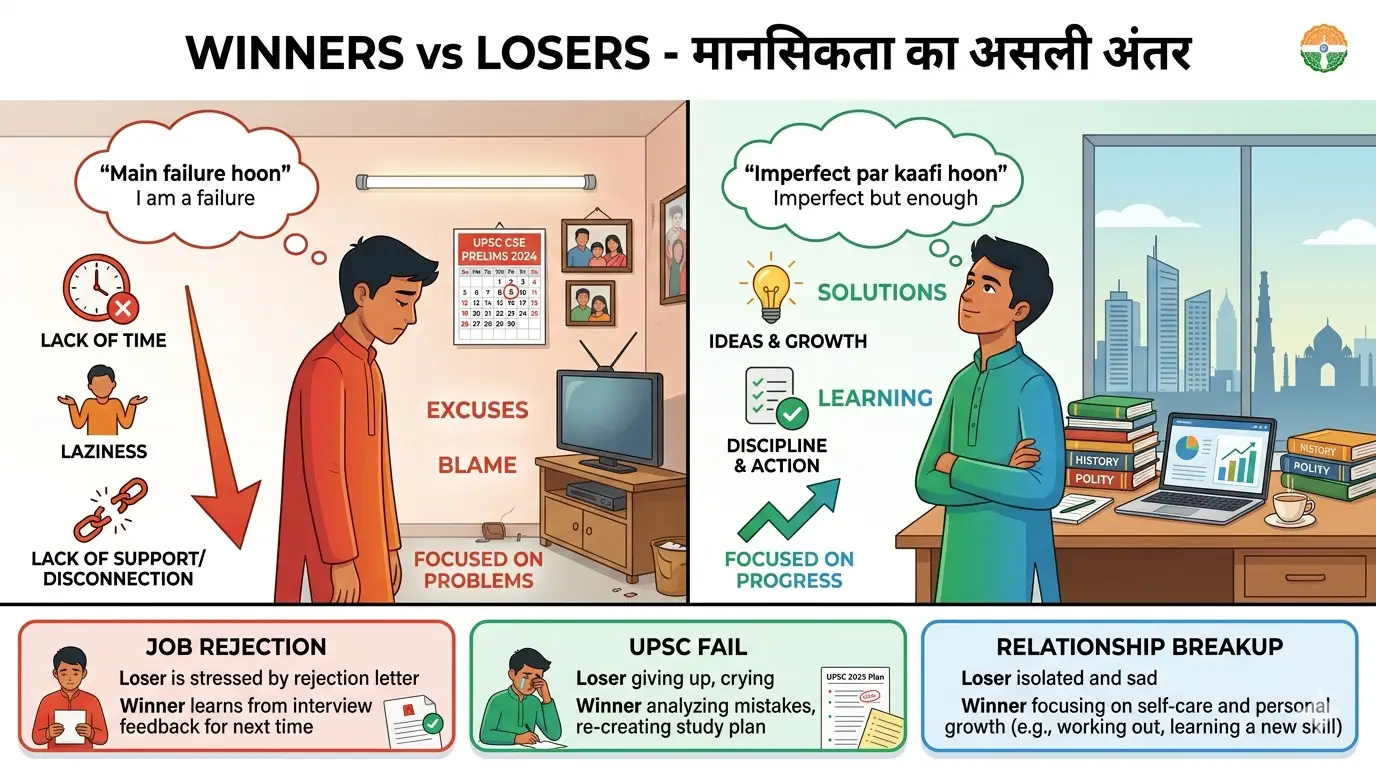
Winners vs Losers — मानसिकता का असली अंतर
| Metric / Dimension | Winners (जीतने वाले) | Losers (हारने वाले) |
|---|---|---|
| Problem Approach | Always part of the solution | Always part of the problem |
| Language & Self-Talk | “Let me do it” / “Possible” | “Not my job” / “Too difficult” |
| Handling Mistakes | Admits mistakes, learns | Blames others, makes excuses |
| View on Commitments | Promises over comfort | Comfort over promises |
| Attitude Toward Failure | “Failure is feedback” | “Failure is final” |
| Responsibility | Takes full responsibility | Blames luck/environment |
| Goal Setting | Specific, measurable goals | Vague goals or no goals |
| Time Management | “Time is money” | “Mujhe time nahi milta” |
| Learning Mindset | “Har roz naya seekhna hai” | “Maine pehle seekh liya” |
| Comparison | Compares with own past self | Compares with others |
| Gratitude | Thankful for what they have | Complains about what is missing |
| Energy Focus | Spends energy on solutions | Spends energy on complaints |
🧠 The “Excuse Mindset” — Invisible Barrier in Indian Workplace
Indian corporate reality: Winners aur losers same company mein hain, par attitude difference hai।
- Winner: Boss ne extra project diya: “Haan, kar dunga”
- Loser: Boss ne extra project diya: “Yeh mera kaam nahi hai”
Excuse Mindset ke 5 Common Patterns:
- “Mujhe time nahi milta” → Reality: Aapko priority nahi hai।
- “Meri company appreciate nahi karti” → Reality: Aapne value create nahi ki।
- “Mere parents ne achhi education nahi dilayi” → Reality: Online courses hain, free hain।
- “Mujhe connections nahi hain” → Reality: LinkedIn pe connect karo।
- “Mera background weak hai” → Reality: Oprah, Kalpana Chawla — sabne weak se shuru kiya।
🎯 Anecdote: The Balloon Seller Story
Ek balloon seller tha। Bachon ko rang-birange balloons bechta tha। Ek din, usne dekha ek black balloon wala baccha udas baitha tha।
Seller ne ek black balloon uthaya, hawa mein chhoda। Woh bhi upar gaya। Seller ne kaha:
“Beta, balloon ka rang nahi, uske andar ki hawa matter karti hai।”
Balloon = Aap | Rang = Outer labels | Andar ki hawa = Attitude
Shiv Khera ka point: “Log aapko outer labels se judge karte hain। Par asli success aapke inner attitude pe depend karti hai।”
📚 Continue Your Learning Journey — Related Summaries
Yeh summaries padh kar aap self-improvement journey ko next level pe le ja sakte ho:
Self-Esteem (आत्म-सम्मान) Masterclass — Khud Par Vishwas Kaise Badhayein
Self-esteem — yeh woh invisible foundation hai jo aapki life ka har decision affect karti hai। Shiv Khera ki “You Can Win” ki second most important chapter hai “Self-Esteem”।
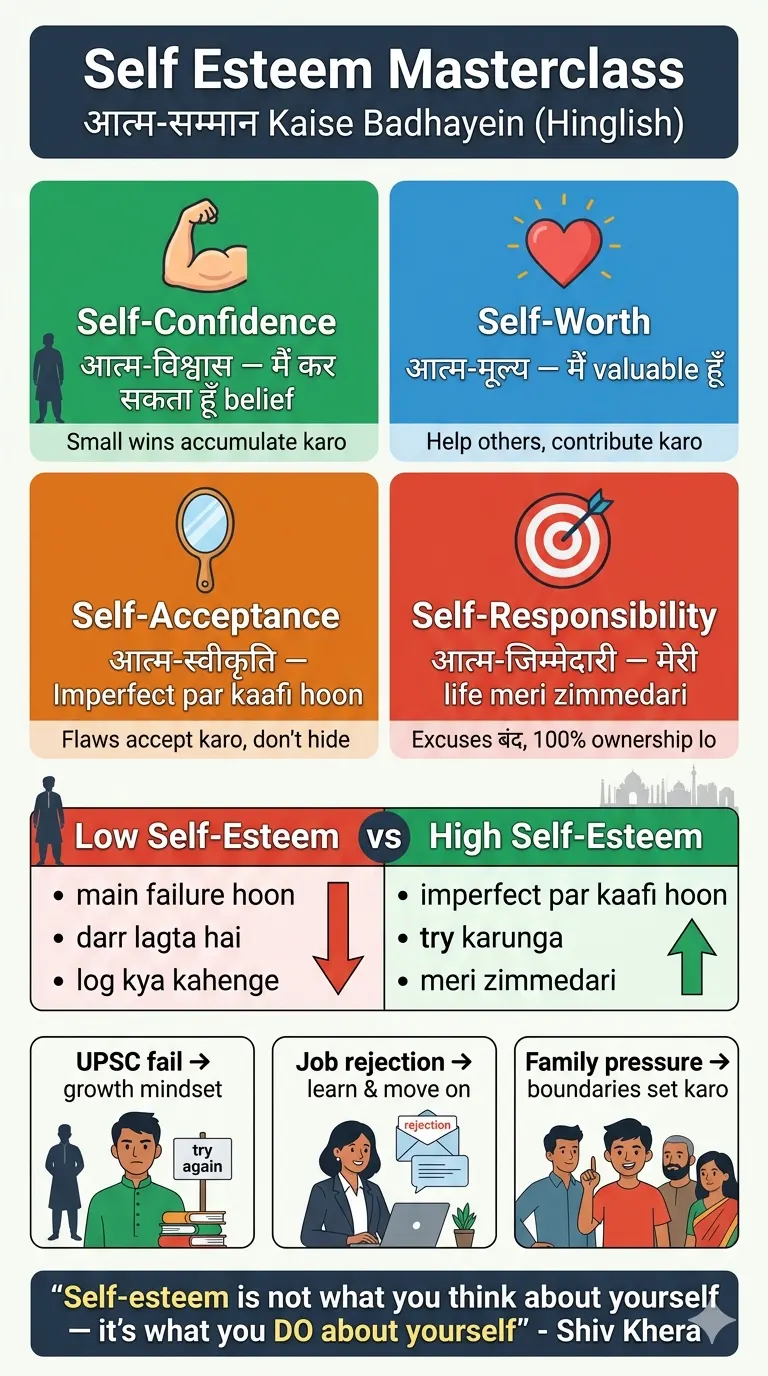
“Self-esteem is not what you think about yourself — it’s what you DO about yourself.”
Kyun? Kyunki self-esteem = aapka internal operating system। Agar OS corrupt hai, toh kitne bhi powerful apps (skills, knowledge, connections) install kar lo, system crash ho jaayega।
📉 Low Self-Esteem vs High Self-Esteem — The Ultimate Matrix
| Dimension | Low Self-Esteem (कम) | High Self-Esteem (उच्च) |
|---|---|---|
| Self-Talk | “main failure hoon” | “main seekh raha hoon” |
| Failure Response | “main kabhi nahi kar paunga” | “yeh feedback hai” |
| Comparison | Doosron se compare karta hai | Khud se compare karta hai |
| Risk-Taking | “mat karo, fail ho jaoge” | “try karo, seekhenge” |
| Decision-Making | “log kya kahenge” | “kya yeh mujhe grow kar raha hai” |
| Accountability | Blame others | 100% ownership |
🧪 Indian Context: Low Self-Esteem Ka Real Impact
Scenario 1: UPSC Aspirant
| Low Self-Esteem | First attempt fail → “main failure hoon” → Depression → Quit |
| High Self-Esteem | First attempt fail → “experience mil gaya” → Resilience → Try again |
Scenario 2: Corporate Employee
| Low Self-Esteem | Boss ne criticize kiya → “main useless hoon” → Stagnation → Resign |
| High Self-Esteem | Boss ne criticize kiya → “feedback mila” → Growth → Improve |
Scenario 3: Entrepreneur
| Low Self-Esteem | Business fail → “main kabhi nahi kar paunga” → Give up |
| High Self-Esteem | Business fail → “kya galt hua? seekh” → Pivot → Try again |
🔺 Shiv Khera’s 4 Pillars of Self-Esteem
Shiv Khera kehte hain: Self-esteem 4 pillars pe tikki hai। Ye chahiye saath saath, ek bhi kamzor ho toh system collapse hoga।
| Pillar | Hindi | What It Means | How to Build |
|---|---|---|---|
| P1 | Self-Confidence | “I can do it” belief | Small wins accumulate karo |
| P2 | Self-Worth | “I am valuable” feeling | Help others, contribute |
| P3 | Self-Acceptance | “Imperfect par kaafi hoon” | Flaws accept karo |
| P4 | Self-Responsibility | “My life meri zimmedari” | Excuses band, ownership lo |
🧱 Pillar 1: Self-Confidence (आत्म-विश्वास) — Small Wins Ka Science
Sach: “Action lo, phir confidence apne aap aayega” — NOT “confidence aaye, phir action lo”।
21-Day Small Wins Challenge:
- Day 1–3: 5 min meditation
- Day 4–6: 10 min walk daily
- Day 7–9: 1 page book padho
- Day 10–15: 5 min affirmations
- Day 16–21: Skill building + Review
Result: Chhote wins = dopamine = confidence compound hota jaata hai।
💎 Pillar 2: Self-Worth (आत्म-मूल्य) — Value Create Karo
Self-worth = “main valuable hoon” ka ehsas। Ye tab aata hai jab aap doosron ki help karte ho।
Kaise build karein?
- Help others (colleague, family, strangers)
- Contribute (community, NGO, social cause)
- Create value (work, content, product)
- Serve (selfless seva, without expectation)
Indian Example: “Mujhe promotion chahiye” (Self-centered) vs “Mujhe team ki help karni hai” (Value-creating)।
Master Acceptance: Read: The Subtle Art of Not Giving a F*ck Summary in Hindi →🪞 Pillar 3: Self-Acceptance (आत्म-स्वीकृति)
Shiv Khera kehte hain: “Flaws hide mat karo — unhe accept karo, phir improve karo।”
Self-Acceptance ≠ Self-Complacency:
- Acceptance: “Main imperfect hoon, par kaafi hoon” → Improve kar sakta hoon
- Complacency: “Main perfect hoon” → Improve karne ki zaroorat nahi
Practice: Roz 3 flaws likho, phir 1 cause karo jiske liye aap responsible ho।
🎯 Pillar 4: Self-Responsibility (आत्म-जिम्मेदारी) — Excuses Band, Ownership Lo
Self-responsibility = “meri life meri zimmedari”। Ye sabse important pillar hai।
| Excuse Mindset ❌ | Responsibility Mindset ✅ |
|---|---|
| “Mujhe time nahi milta” | “Mujhe priority nahi thi” |
| “Meri company appreciate nahi karti” | “Maine value create nahi ki” |
| “Mere parents ne achhi education nahi dilayi” | “Maine online courses nahi kiye” |
| “Mujhe connections nahi hain” | “Maine LinkedIn pe connect nahi kiye” |
| “Mera background weak hai” | “Maine perseverance nahi dikhaya” |
| “Mujhe support nahi mila” | “Maine khud se shuru nahi kiya” |
Shiv Khera ka rule: “100% ownership lo — 0% blame karo।”
Section 6: Low Self-Esteem vs High Self-Esteem (Decision Tree)
Har decision lene se pehle is flowchart ko dimaag mein rakhein:
Section 7: Indian Cultural Deep Dive
🏠 Middle-Class Mindset: The Invisible Cage
Middle-Class Indian Values often trap us:
- Stability = Safety (safe job chahiye, risk nahi lena)
- Risk aversion = Smart ( PIO nahi, secure raho)
- Failure = Shame (fail hone se bacho, bhale hi grow na ho)
Result? Genius potential log 9-to-5 jobs mein stuck hain, jo unhe passion nahi hai।
🎢 Risk Aversion: The Real Killer
Shiv Khera ka rule: “Calculated risk lo — blind risk nahi।”
Formula:
Example: Startup shuru karo — 60% fail, lekin 40% success mein 10x return = Calculated risk worth it।
Manage Your Risk: Read: The Psychology of Money Summary in Hindi →📱 Social Media Comparison: Sharma Ji Ka Beta 2.0
Instagram aur LinkedIn par sab “Perfect” dikhta hai. Par reality mein, sab curated highlights hain।
Shiv Khera ka solution: “Khud se compare karo — aaj vs kal।”
📚 Deep Dive Resources — Continue Your Learning
Yeh summaries padh kar aap self-esteem building journey ko next level pe le ja sakte ho:
Interpersonal Skills (पारस्परिक संबंध) — People Ko Impress Kaise Karein
Shiv Khera ki third pillar: Master the art of human connection। “You can make more friends in 2 months by showing interest in others than in 2 years by trying to get others interested in you.”
Interpersonal Skills — The 85% Success Rule
Success = 15% technical skill + 85% people skill। Kyun? Kyunki log aapki degree se nahi, aapko handle karke judge karte hain।
🤝 The 7 Core Interpersonal Skills
| Skill | Hindi | What It Means | Indian Context Example |
|---|---|---|---|
| S1 | Active Listening | Suno, interrupt mat karo | Boss bol raha hai → Eye contact, nod karo |
| S2 | Empathy | Doosron ki feeling samjho | Colleague stress mein hai → “Kya help kar sakta hoon?” |
| S3 | Communication | Clear & Respectful | “I need help” vs “Sorry, main fit nahi hoon” |
| S4 | Body Language | Open posture, smile | Interview mein confident posture, handshake |
| S5 | Emotional Intelligence | Emotions control karo | Gussa aaya → Deep breath lo, 10 seconds ruko |
| S6 | Conflict Resolution | Win-win solution | Argument → “Dono ki needs kaise meet hongi?” |
| S7 | Giving Feedback | Constructive, not destructive | “Yeh improve kar sakte ho” vs “Tum bekaar ho” |
🎯 Skill 1: Active Listening (सक्रिय सुनना)
Indian Reality: Hum sunte nahi hain, wait karte hain bolne ka।
| Bad Listening ❌ | Active Listening ✅ |
|---|---|
| Phone scroll karte hue suno | Phone side mein, fully present |
| Beech mein bolna shuru | Complete hone tak ruko |
| Apni baat shuru karna | “Aap kya keh rahe ho samajh sakta hoon?” |
| Judgment karna | Understand karna bina judgment |
| Eye contact nahi | Natural eye contact maintain karo |
How to Practice: Har conversation mein 80% suno, 20% bolo।
💝 Skill 2: Empathy (सहानुभूति)
Empathy ≠ Sympathy. Empathy connection create karti hai, sympathy sirf distance maintain karti hai।
| Sympathy ❌ | Empathy ✅ |
|---|---|
| “Mujhe aapke liye afsos hai” | “Mujhe samajh aa raha hai aapko kaisa feel ho raha hai” |
| “I feel for you” | “I feel with you” |
| Distance maintains | Connection creates |
🗣️ Skill 3: Communication (संचार)
Avoid:
- Too indirect (“Shayad, ho sakta hai”)
- Too aggressive (“Yeh karo, abhi!”)
- Too passive (“Ji jo aapka man kare”)
Aim for: “I need this by Friday, can you do it?” (Clear + Respectful)
Master Non-Verbal: Read: Body Language Secrets in Hindi →💪 Skill 4: Body Language (शारीरिक भाषा)
70% communication non-verbal hai — words se zyada important posture, tone, eye contact।
| Aspect | Good ✅ | Bad ❌ |
|---|---|---|
| Posture | Straight, open shoulders | Slouched, crossed arms |
| Eye Contact | Natural (60-70%) | Too much (staring) or too little |
| Smile | Genuine, appropriate | No smile or fake smile |
| Handshake | Firm, not too hard | Droppy bone or vice-grip |
| Tone | Warm, confident | Monotone or aggressive |
🧠 Skill 5: Emotional Intelligence (EQ)
| Component | What It Is | How to Build |
|---|---|---|
| Self-Awareness | Emotions recognize karo | Daily 5 min reflection |
| Self-Regulation | Emotions control karo | Deep breath, pause before reacting |
| Motivation | Internal drive | “Kyun kar raha hoon” clear karo |
| Empathy | Doosron ki feelings | Active listening |
| Social Skills | Relationships manage karo | Regular check-ins with team/family |
⚖️ Skill 6: Conflict Resolution (विवाद समाधान)
4 Approaches:
| Approach | You Win? | They Win? | When to Use |
|---|---|---|---|
| Win-Lose | ✅ | ❌ | Emergency only |
| Lose-Win | ❌ | ✅ | Never (self-sabotage) |
| Lose-Lose | ❌ | ❌ | Never (both harmed) |
| Win-Win | ✅ | ✅ | Always (ideal) |
Win-Win Question: “Dono ki needs kaise meet hongi?”
📝 Skill 7: Giving Feedback (प्रतिपुष्टि देना)
| Bad Feedback ❌ | Constructive Feedback ✅ |
|---|---|
| “Tum bekaar ho” | “Yeh report mein 3 errors the, client ne trust nahi kiya, next time proofread karo” |
| “Sab galat hai” | “Yeh section improve kar sakte ho — more data add karo” |
| “Tumhara attitude kharab hai” | “Meeting mein interruption se team uncomfortable feel karti hai, complete hone tak ruko” |
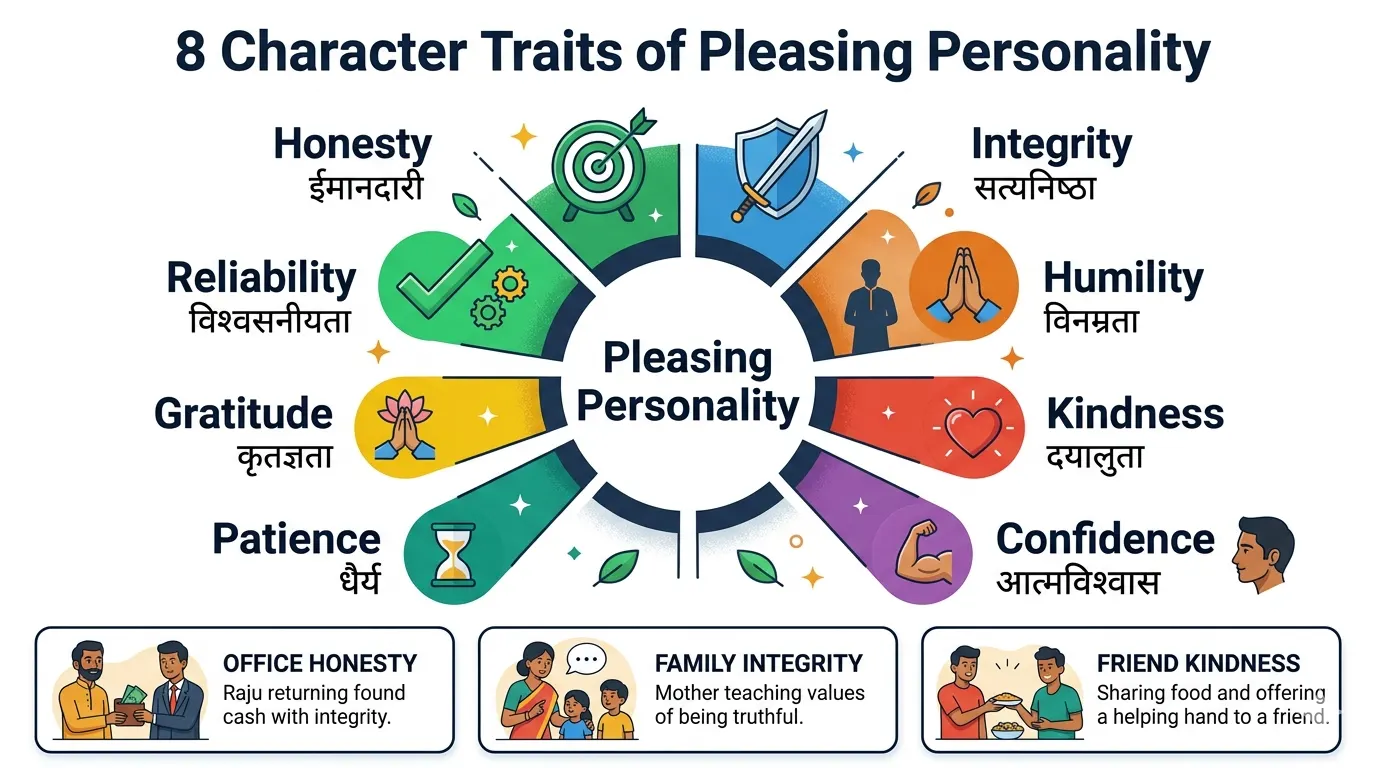
🎨 Building a Pleasing Personality Blueprint
Pleasing Personality ≠ People-Pleasing. Authentic personalities have boundaries and self-respect।
Your Character Traits Development Plan
Use this checklist to track your growth towards the ideal character traits:
📚 Related Summaries — Continue Your Learning Journey
Yeh summaries padh kar aap apne self-improvement journey ko next level pe le ja sakte ho:
Subconscious Mind & Goal Setting — 95% Automatic Behavior Ko Control Karo
Master the engine that runs your life। Shiv Khera ki fourth pillar: “Your subconscious mind accepts whatever you impress upon it.”
The Subconscious Mind: The Real Driver
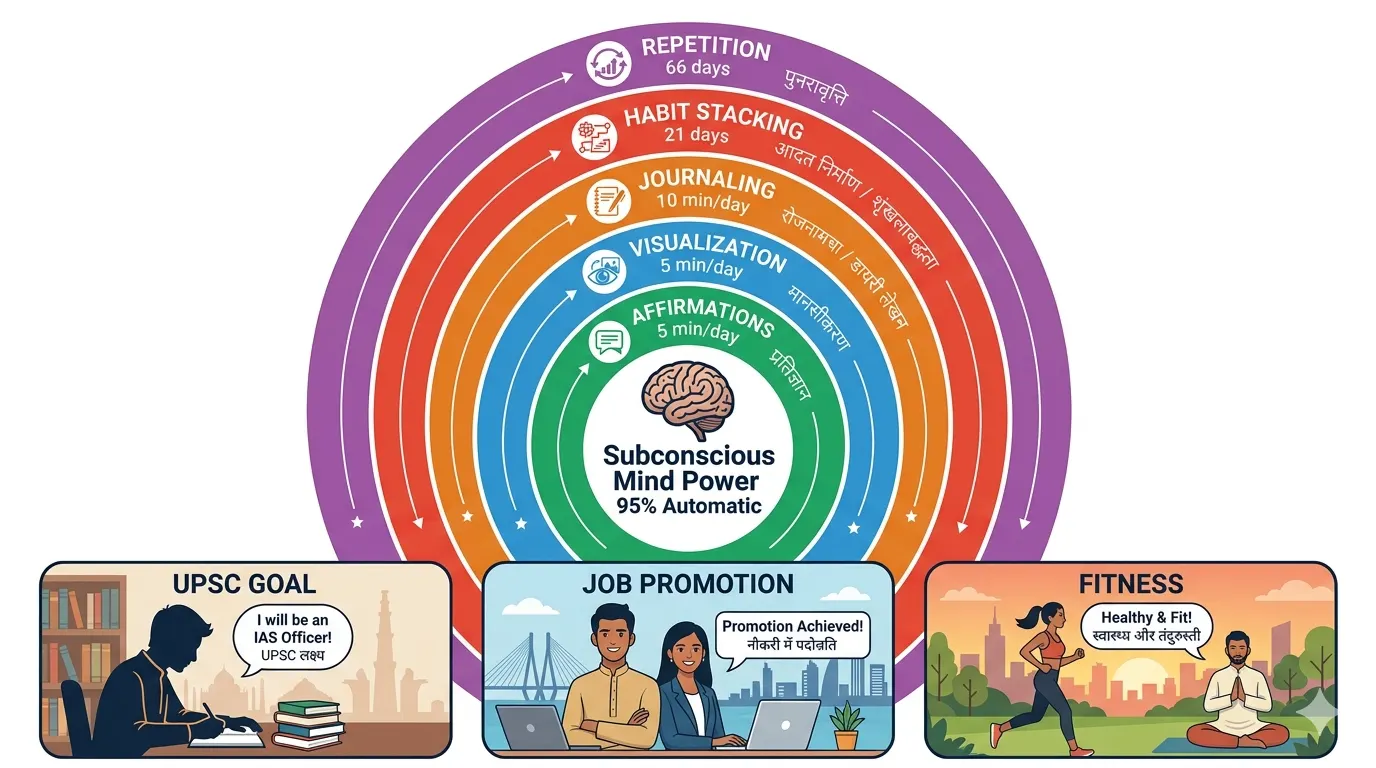
Aapka conscious mind sirf 5% control karta hai, lekin aapka subconscious mind 95% control karta hai। Yeh woh engine hai jo aapki life chala raha hai — automatically।
🧠 Conscious vs Subconscious Mind
| Dimension | Conscious (5%) | Subconscious (95%) |
|---|---|---|
| Function | Thinking, deciding, planning | Habits, emotions, automatic responses |
| Speed | Slow (logical, analytical) | Fast (instant, instinctive) |
| Energy | High (tiring, drains quickly) | Low (effortless, never tired) |
| Duration | Short-term memory | Lifetime memory |
| Control | Willpower-based | Pattern-based |
| Example | Learning to drive (first week) | Driving automatically (after 6 months) |
🔧 5 Techniques for Subconscious Programming
Master Programming Deep Dive: Read: Power of Your Subconscious Mind Summary in Hindi →1. Affirmations (सकारात्मक कथन)
Affirmations = Positive statements jo aap repeat karte ho taaki subconscious mind ko impress ho।
3 Golden Rules:
- Present Tense: “Main hoon” (not “Main hounga”)
- Positive: “Main confident hoon” (not “Main darra hua nahi hoon”)
- Personal: “Main” se start karo
- “Main har roz behtar ho raha hoon”
- “Main khud par bharosa karta hoon”
- “Main success deserve karta hoon”
- “Main challenges ko opportunities mein badalta hoon”
- “Main imperfect hoon, par main kaafi hoon”
Best Time: Subah uth kar (5 min) + Raat sone se pehle (5 min) = 10 min/day
2. Visualization (दृश्यमापन)
Visualization = Apne dimaag mein success ko dekhna, jaise woh already ho chuka ho।
Step-by-Step Process:
- Closed eyes, deep breath (1 min relaxation)
- See yourself succeeding (3 min) — UPSC clear, promotion, business growth
- Add details — colors, sounds, people around you
- Feel the emotions (1 min) — pride, joy, gratitude, excitement
Why It Works: Subconscious mind real aur imaginary ko differentiate nahi kar sakta। Jo aap visualize karte ho, woh brain ko “already hua” lagta hai।
3. Journaling (पत्र लेखन)
Journaling = Self-awareness ka sabse powerful tool।
3-Line Daily Format:
2. Aaj maine kya seekha? (Learning)
3. Kal main kya karunga? (Plan)
Example:
1. Aaj maine 10 pages book padh liye
2. Aaj maine seekha: consistency important hai, intensity nahi
3. Kal main 15 pages padhunga + 5 min affirmations
Time Required: 10 min/day (subah ya raat)
Master Habit Stacking Deep Dive: Read: Atomic Habits Summary in Hindi →4. Habit Stacking (आदत जोड़ना)
Habit Stacking = Nayi aadat ko purani aadat ke saath jodna।
Examples:
- “After morning coffee, I will meditate 5 min”
- “After brushing teeth, I will do 5 affirmations”
- “After dinner, I will read 10 pages”
- “After checking phone, I will write 3-line journal”
Why It Works: Purani habit = trigger (automatic)। Nayi habit ko trigger se jod do = automatic ho jayegi।
5. Repetition (दोहराव)
Repetition = Subconscious ko impress karne ka sabse important rule।
- 21 days: Minimum time for basic habit loop
- 66 days: Average for automatic behavior (scientific study)
- 90 days: Permanent lifestyle change
Rule: Don’t quit before the loop is closed। Agar 21 din tak kiya, toh 70% chance hai ki habit ban jayegi। 66 din tak kiya, toh 90% chance hai।
🎯 SMART Goal Setting — Subconscious Ko Clear Signal
Subconscious mind ko clear signal dena Zaroori hai। Agar goal vague hai, toh result bhi vague hoga। SMART goals use karo।
| Criteria | Question | Bad Example ❌ | SMART Example ✅ |
|---|---|---|---|
| S – Specific | Kya exact chahiye? | “Paisa kamana hai” | “₹10 lakh save karni hai” |
| M – Measurable | Kaise pata chalega? | “Achha perform karna” | “90% marks lane hain” |
| A – Achievable | Realistic hai? | “1 month mein 1 crore” | “3 saal mein UPSC clear” |
| R – Relevant | Important hai? | “Log kya kahenge” | “Society service karungi” |
| T – Time-Bound | Kab tak? | “Kisi din” | “31 Dec 2026 tak” |
📝 SMART Goal Worksheet (Fill This Out)
Specific: _________________________
Measurable: _________________________
Achievable: _________________________
Relevant: _________________________
Time-Bound: _________________________
Goal Progress vs. Monthly Targets
💡 Tip: Har month apni progress track karo। Agar target se peeche ho, toh next month double effort lo।
🌅 The Ultimate Daily Routine — Winners Ka Blueprint
Winners same present mein nahi jeete — unka morning routine alag hota hai। Yeh routine 30 din tak follow karo, life badal jayegi।
🌅 Morning (5:00–7:00 AM)
| 5:00 | Wake up + Glass water |
| 5:05 | 5 Affirmations (mirror ke saamne) |
| 5:10 | 5 Min Visualization (success ko dekho) |
| 5:15 | Meditation (deep breathing) |
| 5:30 | Exercise/Walk (30 min) |
| 6:00 | Shower + Get ready |
| 6:15 | Reading (Book — 45 min) |
| 7:00 | Breakfast + Plan day |
🌆 Evening (8:00–10:00 PM)
| 8:00 | 3-Line Journal likho |
| 8:10 | Gratitude (3 things) |
| 8:20 | Review day (kya achha, kya improve) |
| 8:30 | Family Time (no phone) |
| 9:00 | Light dinner |
| 9:30 | No screens (phone/TV off) |
| 9:45 | 5 Min Visualization (tomorrow) |
| 10:00 | Sleep (7-8 hours zaroori) |
📚 Related Summaries — Continue Your Learning Journey
Yeh summaries padh kar aap apne self-improvement journey ko next level pe le ja sakte ho:
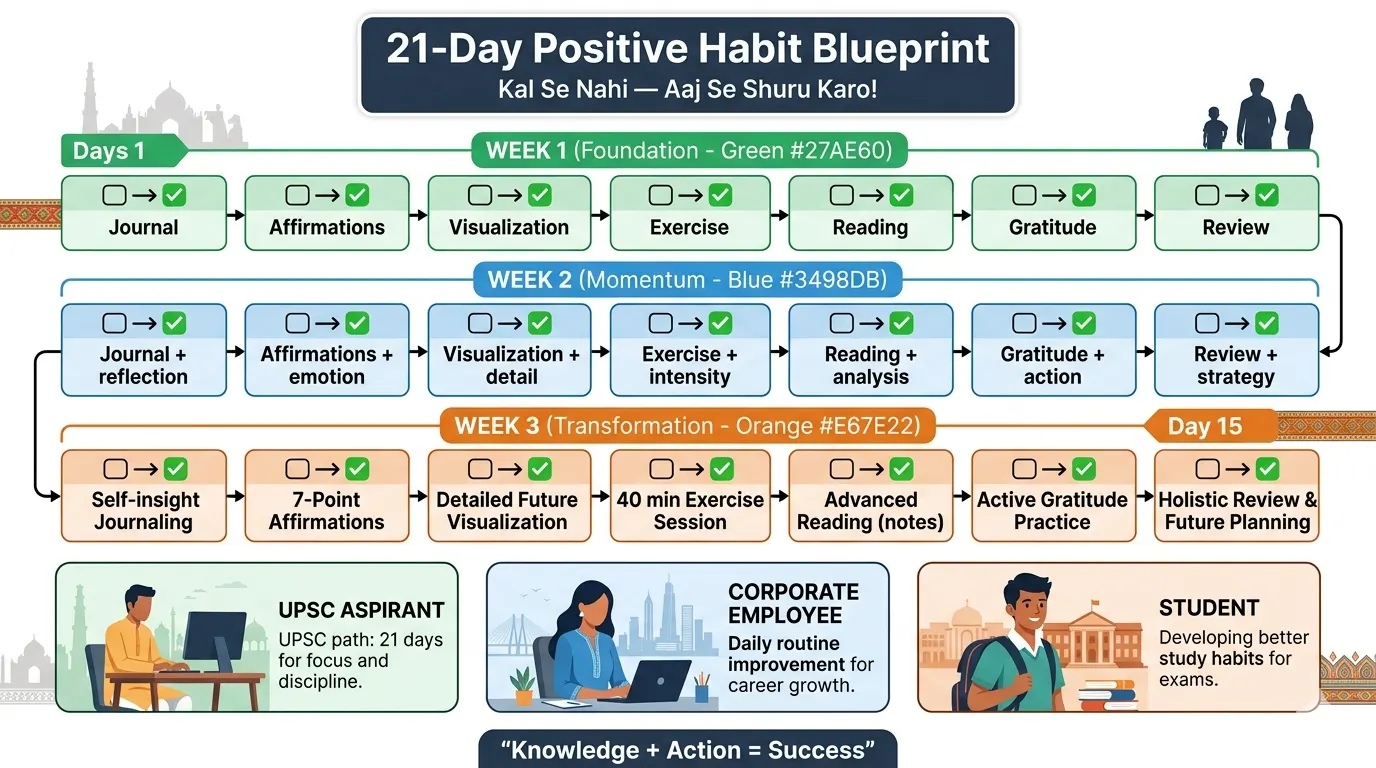
Practical Exercises — 21-Day Positive Habit Blueprint
Shiv Khera’s final pillar: Action. Kal se nahi — aaj se shuru karo। “Knowledge without action is worthless. Action without knowledge is dangerous. Knowledge + Action = Success.”
Section 18: The 21-Day Positive Habit Blueprint — Day-by-Day Action Plan
“Knowledge without action is worthless. Action without knowledge is dangerous. Knowledge + Action = Success.”
Yeh section aapke liye practical, step-by-step, day-by-day action plan hai। Kal se nahi — aaj se shuru karo!
📅 Complete 21-Day Action Plan
| Day | Focus Area | Action Task | Time | Expected Result |
|---|---|---|---|---|
| 1 | Self-Awareness | 3-Line Journal start karo | 10 min | Clarity on current state |
| 2 | Affirmations | 5 Morning Affirmations | 5 min | Positive mindset start |
| 3 | Visualization | 5 Min Success Visualization | 5 min | Subconscious programming |
| 4 | Physical Health | 30 Min Walk/Exercise | 30 min | Energy boost, confidence |
| 5 | Learning | 15 Min Book Reading | 15 min | Knowledge growth |
| 6 | Gratitude | 3 Things Gratitude Journal | 5 min | Positivity increase |
| 7 | Review | Week 1 Progress Review | 15 min | Tracking, motivation |
| 8 | Self-Awareness | Journal Continue + Reflection | 10 min | Pattern recognition |
| 9 | Affirmations | 5 Affirmations + Mirror | 5 min | Self-confidence boost |
| 10 | Visualization | 5 Min + Emotion | 5 min | Stronger subconscious |
| 11 | Physical Health | 30 Min + Stretching | 35 min | Fitness improvement |
| 12 | Learning | 20 Min Book + Notes | 20 min | Deeper understanding |
| 13 | Gratitude | 5 Things + Why | 5 min | Deeper appreciation |
| 14 | Review | Week 2 Progress Review | 15 min | Momentum building |
| 15 | Self-Awareness | Journal + Self-Insight | 15 min | Self-insight |
| 16 | Affirmations | 7 Affirmations | 7 min | Stronger belief |
| 17 | Visualization | 7 Min + Detail | 7 min | Clearer vision |
| 18 | Physical Health | 40 Min + Intensity | 40 min | Fitness gain |
| 19 | Learning | 25 Min + Apply | 25 min | Practical knowledge |
| 20 | Gratitude | 5 Things + Share | 5 min | Connection building |
| 21 | Review | Month Review + Next Plan | 20 min | Transformation visible |
📊 Habit Tracker (Visual Representation)
Note: 80%+ completion = Habit formed!
🎯 Week 1 Deep Dive: Foundation Building
Day 1: Self-Awareness — 3-Line Journal
Task: Har din 3-line journal likho:
- Aaj maine kya kar liya? (Achievement)
- Aaj maine kya seekha? (Learning)
- Kal main kya karunga? (Plan)
Example:
1. Aaj maine 10 pages book padh liye
2. Aaj maine seekha: consistency important hai
3. Kal main 15 pages padhunga
Why Important? Self-awareness = first step to change। Without awareness, you can’t improve।
Day 2: Affirmations — 5 Morning Affirmations
Task: Mirror ke saamne khade ho kar, 5 affirmations bolo (with emotion):
- “Main imperfect hoon, par main kaafi hoon”
- “Main har roz behtar ho raha hoon”
- “Main challenges ko opportunities mein badalta hoon”
- “Main khud par bharosa karta hoon”
- “Main success deserve karta hoon”
Why Important? Affirmations = subconscious reprogramming। Positive input = positive output।
Day 3: Visualization — 5 Min Success Visualization
Task:
- Closed eyes, deep breath (1 min)
- See yourself succeeding (3 min) — UPSC clear, promotion, business growth
- Feel the emotions (1 min) — pride, joy, gratitude
Why Important? Visualization = brain ko signal ki yeh already hua hai। Subconscious automatically actions start karta hai।
Day 4: Physical Health — 30 Min Walk/Exercise
Task: 30 minute walk, jog, yoga, ya gym
Why Important? Physical health = mental health। Energy boost = confidence boost।
Day 5: Learning — 15 Min Book Reading
Task: 15 minutes self-help book padho (not fiction, not social media)
Why Important? Learning = growth। 15 min/day × 365 = 91 hours/year = 10 full days of learning।
Day 6: Gratitude — 3 Things Gratitude Journal
Task: 3 cheezein likho jinke liye aap thankful ho, aur kyun:
- Sehat — healthy body
- Family — support system
- Opportunity — job/business/chance
Why Important? Gratitude = positivity magnet। Jo thankful ho, usse zyada milta hai।
Day 7: Review — Week 1 Progress Review
Task:
- Week 1 mein kitne tasks complete kiye?
- Kya achha laga?
- Kya improve karna hai?
- Week 2 ka plan kya hai?
Why Important? Review = course correction। Without review, you repeat mistakes।
🎯 Week 2 Deep Dive: Momentum Building (Days 8–14)
Same tasks, deeper implementation:
| Day | Focus | Upgrade |
|---|---|---|
| 8 | Journal | Add reflection (kya pattern dekh rahe ho?) |
| 9 | Affirmations | Mirror ke saamne, eye contact |
| 10 | Visualization | Add emotions (pride, joy, gratitude) |
| 11 | Exercise | Add stretching + intensity |
| 12 | Reading | Add notes + application |
| 13 | Gratitude | Add “why” (deep reason) |
| 14 | Review | Add momentum building |
🎯 Week 3 Deep Dive: Transformation Visible (Days 15–21)
Advanced implementation:
| Day | Focus | Upgrade |
|---|---|---|
| 15 | Journal | Add self-insight (kya seekha apne bare mein?) |
| 16 | Affirmations | 7 affirmations (2 new add karo) |
| 17 | Visualization | 7 min + more detail |
| 18 | Exercise | 40 min + higher intensity |
| 19 | Reading | 25 min + apply immediately |
| 20 | Gratitude | 5 things + share with someone |
| 21 | Review | Month review + next month plan |
🎉 Day 21 Celebration
21 days = Habit formed! Ab ye tasks automatic ho gaye hain। Ab next level pe jao — 66 days repetition for permanent habit।
Section 19: “How to Stop Making Excuses Today” — Action Checklist
Excuse Mindset = Invisible Barrier। Yeh checklist aapko excuses todne mein help karegi।
| # | Excuse | Reality | Action | Done? |
|---|---|---|---|---|
| 1 | “Mujhe time nahi milta” | Priority nahi hai | 15 min/day schedule karo | ☐ |
| 2 | “Meri company mujhe appreciate nahi karti” | Value create nahi ki | Extra value create karo | ☐ |
| 3 | “Mere parents ne achhi education nahi dilayi” | Online courses free hain | 1 free course start karo | ☐ |
| 4 | “Mujhe connections nahi hain” | LinkedIn pe 1000+ professionals hain | 5 LinkedIn connections karo | ☐ |
| 5 | “Mera background weak hai” | Oprah, Aravindo, Kalpana Chawla ne weak se shuru kiya | Perseverance dikhao | ☐ |
| 6 | “Main failure hoon” | Failure = feedback, not final | 1 small win today | ☐ |
| 7 | “Log kya kahenge” | Doosron ki soch = unki zimmedari | 1 action without worry | ☐ |
| 8 | “Mujhe confidence nahi hai” | Confidence = action ke baad aata hai | 1 action before confidence | ☐ |
| 9 | “Main enough hoon nahi” | Imperfect par kaafi hoon | Self-acceptance practice | ☐ |
| 10 | “Kal se shuru karunga” | Kal kabhi nahi aata | TODAY start karo | ☐ |
🔥 5-Minute “No More Excuses” Challenge
Rule: 5 minute mein, 1 excuse tod do aur 1 action lo।
| Time | Task | Example |
|---|---|---|
| 0:00–1:00 | Identify excuse | “Mujhe time nahi milta” |
| 1:00–2:00 | Reframe reality | “Priority nahi thi, time mil sakta hai” |
| 2:00–3:00 | Choose action | “15 min book padhunga today” |
| 3:00–4:00 | Set reminder | Phone alarm set karo |
| 4:00–5:00 | TAKE ACTION! | Book kholo, pehla page padho |
Result: 5 minute mein, aap excuse todkar action le liya।
Section 20: 60-Second Takeaway Bullet Lists
🎯 You Can Win — 60-Second Summary
- Success = 85% Attitude + 15% Smart Skill
- Winners don’t do different things — they do things differently
- Self-esteem = what you DO, not what you think
- Subconscious mind = 95% automatic behavior
- Knowledge + Action = Success (Knowledge without action = worthless)
- 21 days = Habit formation minimum
- SMART Goals = Specific, Measurable, Achievable, Relevant, Time-Bound
- Affirmations = 5 min/day, present tense, positive, personal
- Visualization = 5 min/day, see success, feel emotions
- Journaling = 3-line daily (achievement, learning, plan)
- Excuses = Invisible barrier (break them today)
- Self-acceptance = “Imperfect par kaafi hoon”
- Responsibility = 100% ownership, 0% blame
- Comparison = Khud se karo (aaj vs kal), doosron se nahi
- Gratitude = 3 things/day, positivity magnet
🚀 5 Pillars of Success (Shiv Khera’s Framework)
- Attitude: 85% success = attitude | Daily: 5 min affirmations
- Self-Esteem: What you DO | Daily: 3-line journal
- Interpersonal Skills: 85% success = people skill | Daily: 1 active listening
- Subconscious Mind: 95% automatic behavior | Daily: 5 min visualization
- Action: Knowledge + Action = Success | Daily: 1 task today
💡 Winners vs Losers — 60-Second Recall
| Metric | Winners ✅ | Losers ❌ |
|---|---|---|
| Problem Approach | Part of solution | Part of problem |
| Language | “Let me do it for you” | “Not my job” |
| Mistakes | Admit, learn, move on | Blame, excuse, repeat |
| Promises | Over comfort | Comfort over promises |
| Failure | Feedback, not final | Final destination |
| Attitude | Positive, proactive | Negative, reactive |
| Responsibility | 100% ownership | 0% ownership, 100% blame |
| Time | Today (kal nahi) | “Kal se shuru karunga” |
📊 Your Progress Visualization (Habit Heatmap)
Visualizing your 21-day consistency pattern:
(Green = Completed | Gray = Missed) — 80%+ = Habit formed!
🎯 Ab Aapki Baari: Action Lo, Jeet Lo!
You Can Win summary padh kar aapne pehla step le liya hai। Ab dosra step hai — action lena।
“Winners don’t do different things, they do things differently.” — Shiv Khera
Aaj se shuru karein:
📚 Further Reading — Top Self-Help Books in Hindi
Yeh books aapke mindset, habits, aur life ko transform kar sakti hain। Har ek ko deeply padho, aur life mein implement karo:
🧠 Mindset & Attitude Mastery
| Book | Author | Read Summary |
|---|---|---|
| As A Man Thinketh | James Allen | → Summary |
| The Power of Positive Thinking | Norman Vincent Peale | → Summary |
| Think and Grow Rich | Napoleon Hill | → Summary |
| The Secret | Rhonda Byrne | → Summary |
| Attitude Is Everything | Keith Ferrazzi | → Summary |
| The Subtle Art of Not Giving a F*ck | Mark Manson | → Summary |
| The Power of Now | Eckhart Tolle | → Summary |
🔄 Habits & Daily Success Systems
| Book | Author | Read Summary |
|---|---|---|
| Atomic Habits 🔥 | James Clear | → Summary |
| The 7 Habits of Highly Effective People | Stephen Covey | → Summary |
| The Compound Effect | Darren Hardy | → Summary |
| The 5 AM Club | Robin Sharma | → Summary |
| The Courage to Be Disliked | Ichiro Kishimi | → Summary |
💰 Money Mindset & Wealth Building
| Book | Author | Read Summary |
|---|---|---|
| The Psychology of Money 🔥 | Morgan Housel | → Summary |
| The Richest Man in Babylon | George Clason | → Summary |
| The Intelligent Investor | Benjamin Graham | → Summary |
| The Millionaire Fastlane | MJ DeMarco | → Summary |
| The Almanack of Naval Ravikant | Naval Ravikant | → Summary |
🌟 Life Philosophy & Ancient Wisdom
| Book | Author | Read Summary |
|---|---|---|
| Ikigai | Héctor García | → Summary |
| The Alchemist | Paulo Coelho | → Summary |
| Chanakya Neeti | Chanakya | → Summary |
| Sapiens | Yuval Noah Harari | → Summary |
| Zero to One | Peter Thiel | → Summary |
💞 Relationships & Human Nature
| Book | Author | Read Summary |
|---|---|---|
| Men Are From Mars, Women Are From Venus | John Gray | → Summary |
| Kamasutra | Vatsyayana | → Summary |
📖 You Can Win — Own Your Copy Today
Yeh book aapke life ka turning point ban sakti hai। Physical copy order karo, har roz padho, aur rules ko implement karo।
⚠️ Note: Amazon links are affiliate links — aapko koi extra cost nahi hoti, par humein support milta hai free premium content banane mein।
🏆 “You Can Win” — Kyunki Jeet Aapki Hai!
“Attitude positive ho, action consistent ho, aur self-belief strong ho — toh jeet aapke kadam chumeGI।”
— Shiv Khera, You Can Win
❓ Frequently Asked Questions
You Can Win — Shiv Khera के बारे में सबसे ज्यादा पूछे जाने वाले सवाल
You Can Win, global bestseller और Indian author Shiv Khera द्वारा लिखी गई एक transformative self-help book है। इस किताब का मूल मंत्र है:
यह पुस्तक व्यक्ति को सही Attitude, मजबूत Character, और Positive Action के जरिए सफलता हासिल करना सिखाती है।
इस book को 20+ languages में translate किया जा चुका है, और 5+ million copies खप चुकी हैं globally।
इस famous quote का मतलब है:
Example से समझो:
| Metric | Winners (जीतने वाले) | Losers (हारने वाले) |
|---|---|---|
| Problem | समाधान का हिस्सा बनाते हैं | समस्या का हिस्सा बन जाते हैं |
| Mistakes | Admit करते हैं, learn करते हैं | Blame करते हैं, excuse बनाते हैं |
| Language | “Let me do it for you” | “That is not my job” |
| Failure | Feedback समझते हैं | Final मान लेते हैं |
3-Step Process follow करो:
Step 1: Triple-E Architecture समझो
| Factor | Hindi | What It Means |
|---|---|---|
| Environment | माहौल | Home, Culture, Media, Peers |
| Experience | अनुभव | Past reference points, Failures, Successes |
| Education | शिक्षा | Formal + Informal learning, Mentors |
Step 2: Daily Practices
- Daily 5 min affirmations बोलो (mirror के सामने)
- 5 min visualization करो (success mentally देkho)
- 3-Line Journal लिखो (Achievement, Learning, Plan)
- 15 min book पढ़ो (self-help, not fiction)
Step 3: 21 Days Continue करो
Shiv Khera के 4 Pillars follow करो:
| Pillar | Hindi | How to Build |
|---|---|---|
| Self-Confidence | आत्म-विश्वास | Small wins accumulate करो |
| Self-Worth | आत्म-मूल्य | Help others, contribute करो |
| Self-Acceptance | आत्म-स्वीकृति | “Imperfect par kaafi hoon” मानो |
| Self-Responsibility | आत्म-जिम्मेदारी | Excuses बंद, 100% ownership lo |
Separation of Tasks apply करो (Adlerian Psychology से):
3-Step Process:
- Step 1 – Recognize: “Yeh doosron ki task है, meri नहीं”
- Step 2 – Reframe: “Unki सोच unki zimmedari, meri choice meri zimmedari”
- Step 3 – Act: Apne values par kaam करो, approval की चिंता मत करो
Indian Examples:
| Scenario | Kiski Task? | Kya Karna Chahiye? |
|---|---|---|
| Parents ne marriage pressure diya | Parents ki task | Unki concern suno, par apna decision lo |
| Boss ne criticize kiya | Boss ki opinion | Feedback lo, par self-worth par dhyan mat do |
| Log kya kahenge? | Doosron ki soch | Ignore karo, apne values pe focus karo |
Shiv Khera के अनुसार:
- Failure = feedback, not final
- Admit mistake, learn, move on
- Small daily actions lo
- 21-Day Positive Habit Blueprint follow करो
- Visualization करो कि आप सफल हो गए हैं
Habit Stacking technique use करो:
Examples:
| Current Habit | New Habit | Stack |
|---|---|---|
| Morning coffee | 5 min meditation | “After coffee, meditate 5 min” |
| Brush teeth | 2 affirmations | “After brushing, say 2 affirmations” |
| Lunch | 1 gratitude | “After lunch, write 1 gratitude” |
Self-Confidence build करने के लिए:
- Small wins accumulate करो (हर छोटा success count करता है)
- Daily 5 min affirmations बोलो
- 3-Line Journal लिखो
- 21-Day Habit Blueprint follow करो
- Visualization करो
Example:
| Day | Action | Expected Win |
|---|---|---|
| 1–3 | 5 min meditation | Mind calm, focus badha |
| 4–6 | 10 min walk daily | Energy badha, stress kam |
| 7–9 | 1 page book padho | Learning habit shuru |