
The Courage to Be Disliked Summary in Hindi: लोग क्या कहेंगे का डर खत्म!

The Courage to Be Disliked, जापानी लेखक Ichiro Kishimi और Fumitake Koga द्वारा Alfred Adler की psychology पर आधारित एक self-help book है जो बताती है कि कैसे हम दूसरों की पसंद-नापसंद से मुक्त होकर अपनी जिंदगी को स्वेच्छा (voluntarily) से जी सकते हैं।
क्या आपने कभी महसूस किया है कि आपकी जिंदगी आपकी नहीं, बल्कि “लोगों की” चल रही है?
चाहे वह career choice हो, शादी का pressure, या शर्मा जी के बेटे से comparison—हम सब एक ऐसे invisible cage में कैद हैं जिसका नाम है “लोग क्या कहेंगे।”
यह article कोई boring summary नहीं है। यह एक Socratic संवाद (Dialogue) है। इसमें एक Youth है—जो गुस्से में है, frustrated है, और अपने past के बोझ तले दबा हुआ है—और एक Philosopher है, जो उसे Adlerian psychology के ज़रिए अज़ादी का रास्ता दिखाता है।
- Night 1: Trauma एक सच नहीं, एक कहानी है जो हम खुद को सुनाते हैं।
- Night 2: Self-acceptance और “Disliked होने का साहस।”
- Night 3: Separation of Tasks—कौनसा काम किसका है?
- Night 4: Horizontal Relationships—Equality vs. Superiority.
- Night 5: Community Feeling—दुनिया से जुड़ने का सही तरीका।
Alfred Adler कौन थे? Adler vs Freud vs Jung
Adler को अक्सर Freud और Jung के बीच भुला दिया जाता है, लेकिन उनकी सोच modern self-help का असली backbone है। जहाँ Freud ‘Past’ की बात करते हैं, Adler ‘Purpose’ की बात करते हैं।
| Metric | Sigmund Freud | Alfred Adler | Carl Jung |
|---|---|---|---|
| Core Belief | Etiology (Past): बचपन के trauma और instincts आपका आज decide करते हैं। | Teleology (Goal): आपका आज का ‘Goal’ आपका behavior decide करता है। | Collective Unconscious: हमारे अंदर पुराने symbols और archetypes होते हैं। |
| View on Trauma | Trauma आपको “trap” कर देता है। | Trauma एक “excuse” है जो हम अपने goals के लिए use करते हैं। | Trauma को symbol के रूप में integrate करना होता है। |
| Indian Example | “मेरे पापा strict थे, इसलिए मैं आज डरता हूँ।” | “मैं डरता हूँ ताकि मुझे risk लेने की responsibility न लेनी पड़े।” | “मेरी family की history में एक pattern है, मुझे उसे समझना होगा।” |
🛒 इस बेहतरीन पुस्तक को सीधे Amazon से ऑर्डर करें:
नीचे दिए गए लिंक्स बुक लवर्स के वेरीफाइड एफ़िलिएट लिंक्स हैं:
Teleology vs Etiology — वो Trauma जो असल में Trauma नहीं है?
यह इस book का सबसे controversial part है। Adler कहते हैं: “Trauma exist नहीं करता (as a cause)।” यह सुनने में कड़वा है, लेकिन यही आपकी अज़ादी की पहली सीढ़ी है।
Youth का तीखा सवाल और दार्शनिक का जवाब:
Teleology कहती है: ‘Present Goal ← Use of Past Event (A)’.
यहाँ तुम्हारा Goal है: ‘Failure और criticism के दर्द से बचना।’ और उस goal को पूरा करने के लिए, तुमने अपने Past Trauma को एक valid reason बना लिया है। तुम trauma का इस्तेमाल कर रहे हो ताकि तुम्हें आज के risk से न लड़ना पड़े। Past तुम्हारा ‘Reason’ है, लेकिन ‘Cause’ तुम्हारा अपना आज का goal है।”

🔍 Case Study: Ritu (The Delhi Professional)
Ritu, एक 28-साल की professional, school में हुई public shaming की वजह से आज भी meetings में चुप रहती है।
- Etiology Narrative: “School में बेइज़्ज़ती हुई → इसलिए मैं आज चुप रहती हूँ।” (She feels trapped).
- Teleology Reframe: “Ritu आज चुप रहती है ताकि meeting में गलती न हो और उसे फिर से शर्मिंदा न होना पड़े। उसका goal ‘Short-term Emotional Safety’ है।”
जब Ritu को समझ आता है कि उसका ‘Silence’ एक choice है (भले ही unconscious हो), तभी वह उसे बदल सकती है।
अगली बार जब आप कहें, “इसलिए मैं ऐसा हूँ…”, तो रुकिए और देखिए:
Part 1 में, हमने देखा कि कैसे हम अपने past को एक ‘excuse’ की तरह use करते हैं। लेकिन एक सवाल अब भी दिमाग में घूम रहा होगा: “अगर मैं दूसरों की परवाह करना छोड़ दूँ, तो क्या मैं अकेला हो जाऊँगा? मैं रिश्ते कैसे निभाऊँगा?”
इसका जवाब छुपा है इस book के सबसे revolutionary concept में: Separation of Tasks। अगर आपको “लोग क्या कहेंगे” की बीमारी से हमेशा के लिए छुटकारा पाना है, तो यह section आपका ‘Manual of Freedom’ है।
Separation of Tasks Masterclass — Adler Hindi me, step-by-step
💡 Separation of Tasks क्या है?
Separation of tasks (Alfred Adler) का मतलब है: हर इंसान की जिम्मेदारियों को पहचानो—कौन सा काम किसका है—और दूसरों के tasks में घुसना बंद करो। इससे आप mental boundaries बनाते हो, approval की चिंता कम होती है, और आप अपनी choices पर focus कर पाते हो। जब आप यह समझ जाते हैं कि दूसरों का reaction उनका task है, तब आप ‘लोग क्या कहेंगे’ के डर से आज़ाद हो जाते हैं।

Core Idea: Boundary Set Karne Ka Logic
Adler कहते हैं कि दुनिया में हर चीज़ एक ‘Task’ है। Problems तब शुरू होती हैं जब हम दूसरों की task को control करने की कोशिश करते हैं।
- आपकी Task: आपके decisions, आपका काम, आपकी मेहनत, और आपकी feelings।
- दूसरों की Task: उनके reactions, उनका judgment, उनकी approval, और उनके emotions।
जब हम दूसरों की approval लेने के लिए अपने values से compromise करते हैं (Interfering in their task) या दूसरों को बदलने की कोशिश करते हैं ताकि हमें बुरा न लगे (Trying to control their task), तब जीवन में असली तनाव पैदा होता है।
🛠 2×2 Separation-of-Tasks Matrix (India-Optimized)
इस matrix को अपने पास सेव कर लीजिए। जब भी stress हो, इसे देखिए:
| Category | Yeh Task MERA Hai (I Control) | Yeh Task DUSRON Ki Hai (I Don’t Control) |
|---|---|---|
| Action / Decision | मेरी career choice, मेरा पढ़ना, मेरा बोलना, मेरा lifestyle। | Parents की expectations, relatives के comments, “शर्मा जी” का opinion। |
| Reaction / Feeling | मेरी feelings (shame, fear)—मैं इन्हें manage कर सकता हूँ। | दूसरों के reactions (judgment, approval)—यह उनकी ज़िम्मेदारी है। |
| Example (Career) | मैं मेहनत करूँगा और अपना रास्ता चुनूँगा। | Parents को क्या लगेगा या लोग क्या कहेंगे। |
| Example (Marriage) | मैं अपने values के हिसाब से partner choose करूँगा। | Family के WhatsApp groups में होने वाली gossip। |
| Action Step | Boundary set करो: “मैं यह choose करता हूँ।” | Accept करो: उनका reaction उनका है, मेरा नहीं। |
🛒 अपनी पर्सनल लाइब्रेरी के लिए यह बुक आर्डर करें:
नीचे दिए लिंक्स सीधे एमेज़ॉन स्टोर के ऑफिशियल सर्टिफाइड एफ़िलिएट लिंक्स हैं:
🎭 Dialogue: Youth vs Philosopher — The Freedom of Being Disliked
Youth का तीखा सवाल और दार्शनिक का अकाट्य जवाब:
1. तुम्हारा Career Choice: यह तुम्हारी task है।
2. Parents की Expectations: यह उनकी task है。
3. लोगों के Comments: यह उनकी task है。
जब तुम उनकी expectations (Task 2) Aur लोगों के comments (Task 3) को control करने की कोशिश करते हो, तो तुम अपनी energy waste कर रहे हो। तुम्हारा काम सिर्फ Task 1 पर focus करना है। अगर तुमने अपना काम पूरी ईमानदारी से किया, तो उनका ‘नाराज़ होना’ उनका अपना task है। तुम उन्हें खुश करने के लिए अपनी ज़िन्दगी का बलिदान नहीं दे सकते।”
💻 Python: Separation of Tasks Decision Tree
अगर आप logic-driven thinker हैं, तो नीचे दिए गए कोड को रन करके अपना खुद का “Decision Freedom Tree” जनरेट कर सकते हैं। यह आपको तुरंत बताएगा कि आप किस टास्क में फंसे हुए हैं।
import matplotlib.pyplot as plt
import matplotlib.patches as patches

# Create figure
fig, ax = plt.subplots(figsize=(10, 8))
ax.set_xlim(0, 10)
ax.set_ylim(0, 10)
ax.axis('off')

title = "Separation of Tasks — Adlerian Decision Tree (Hindi)"
ax.text(0.5, 9.5, title, fontsize=14, fontweight='bold', ha='center', va='top')

# Functions to draw boxes and text
def draw_box(x, y, text, color='#4CAF50'):
    rect = patches.Rectangle((x, y), 3, 0.6, linewidth=1.5, edgecolor='black', facecolor=color)
    ax.add_patch(rect)
    ax.text(x + 1.5, y + 0.35, text, fontsize=10, ha='center', va='middle', fontweight='bold')

def draw_arrow(x1, y1, x2, y2):
    ax.annotate('', xy=(x2, y2), xytext=(x1, y1),
                arrowprops=dict(arrowstyle='->', lw=1.5, color='black'))

# Root node
draw_box(3.5, 8, "Kya yeh decision/action mere control mein hai?")

# Yes branch
draw_arrow(5, 7.7, 3, 6.5)
draw_arrow(5, 7.7, 7, 6.5)

# Yes node
draw_box(2, 6, "Yeh MERI TASK hai", color='#4CAF50')
draw_box(6, 6, "Yeh DUSRON ki TASK hai", color='#FF9800')

# Yes branch actions
draw_arrow(3.5, 5.7, 2, 4.5)
draw_arrow(3.5, 5.7, 5, 4.5)

draw_box(0.5, 4, "Apni task par action lo\n(apply, bolo, choose karo)", color='#4CAF50')
draw_box(4.5, 4, "Doosron ki reaction\nunki zimmedari — accept karo", color='#FF9800')

# No branch
draw_arrow(7.5, 5.7, 6.5, 4.5)
draw_box(5, 2.5, "Boundary set karo\n'Yeh meri zimmedari nahi'", color='#F44336')

# Final note
ax.text(5, 0.8, "Remember: Approval par depend mat raho — khud ki task par focus karo",
        fontsize=9, ha='center', va='bottom', style='italic', color='#555')

plt.tight_layout()
plt.show()
🇮🇳 Indian Cultural Deep Dive: The “Log Kya Kahenge” Ecosystem
Adlerian psychology को India में apply करना थोड़ा challenging है क्योंकि हमारी सोसाइटी “Collectivist” है। यहाँ “Individualism” को अक्सर स्वार्थ (Selfishness) समझ लिया जाता है।

🏠 1. Joint Family Boundary Nightmare
Indian families में decisions collective होते हैं। अगर आपने कुछ अलग चुना, तो उसे “Family Disrespect” का नाम दे दिया जाता है।
Scenario: आप 28 साल के हैं और आप एक startup join करना चाहते हैं, पर चाचा/मामी चाहते हैं कि आप सरकारी नौकरी करें।
Adlerian Fix: आप उन्हें respect दे सकते हैं (Your Task), लेकिन उनका डर और उनका opinion उनका टास्क है (Their Task)। बाउंड्री सेट करना disrespect नहीं, self-respect है।
🎓 2. Career Guilt (UPSC/IIT/Medical Pressure)
इंडिया में एक success formula फिक्स है। अगर आप उसमें फिट नहीं होते, तो आपको “Failure” का लेबल मिल जाता है।
Teleology Lens: जब आप कहते हैं, “मैं फेल होने से डरता हूँ इसलिए मेहनत नहीं कर रहा,” तो आप अपने ‘Fear of Shame’ के लिए past का सहारा ले रहे हैं। आपका गोल है ‘शर्म से बचना’, ‘कामयाबी पाना’ नहीं।
💍 3. Arranged Marriage Verification Loops
Marriage में caste, income, और family reputation का प्रेशर बहुत ज़्यादा होता है।
The Boundary: पार्टनर की compatibility और आपके values आपका टास्क हैं। Relatives का बैकग्राउंड चेक करना और उनके कमेंट्स उनका टास्क है। उनके WhatsApp judgmental comments को अपने दिमाग में जगह मत दीजिए।

📱 4. The WhatsApp Judgmental Ecosystem
“बेटा, शादी कब कर रहे हो?” या “तुम्हारे कज़िन ने तो नौकरी पा ली।” ये मैसेजेस social anxiety पैदा करते हैं। Adlerian fix simple है: “यह उनका task है, मेरा नहीं।” उनका मैसेज उनकी लाइफस्टाइल है, आपकी रियलिटी नहीं।
Step-by-Step Featured Snippet Guides (Actionable)
🚀 How to start being disliked today — 5-minute checklist
🧘 Log kya sochenge stress solution — 60-second steps
🌱 Khud ko accept karna kaise seekhein — 3-step guide
PART 3: Interpersonal Problems, Relationship Blueprints, and Visualization
Interpersonal Problems — Adler के हिसाब से सब दर्द का कारण
💡 Interpersonal Problems क्या हैं?
Interpersonal problems (Adler) का मतलब है: जीवन की ज़्यादातर तकलीफों का कारण दूसरों के साथ हमारे रिश्ते हैं—जैसे Comparison, Competition, Approval-seeking, और Control। Adler का मानना है कि हम अपनी Self-worth को दूसरों से compare करके तय करते हैं, जिससे हम हमेशा Inferiority या Superiority complex के जाल में फँसे रहते हैं।
Core Concept: Comparison का जाल
हम अपनी Value को दूसरों के तराजू में तौलते हैं कि “क्या मैं कामयाब हूँ या नहीं?”
- Inferiority Complex: जब हम सोचते हैं, “मैं दूसरों से कम हूँ।”
- Superiority Complex: जब हम सोचते हैं, “मैं सबसे ऊपर हूँ और सबको नीचा दिखा सकता हूँ।”
The Conflict: जब हम दूसरों को control करने की कोशिश करते हैं (उनकी Approval लेने या उनके Behavior को बदलने के लिए), तब असली तनाव (Stress) पैदा होता है।
Horizontal vs Vertical Relationships Blueprint
रिश्तों को समझने के लिए Adler ने दो मुख्य Framework दिए हैं। यदि आप गलत Framework चुनते हैं, तो आप कभी शांति नहीं पा सकते।
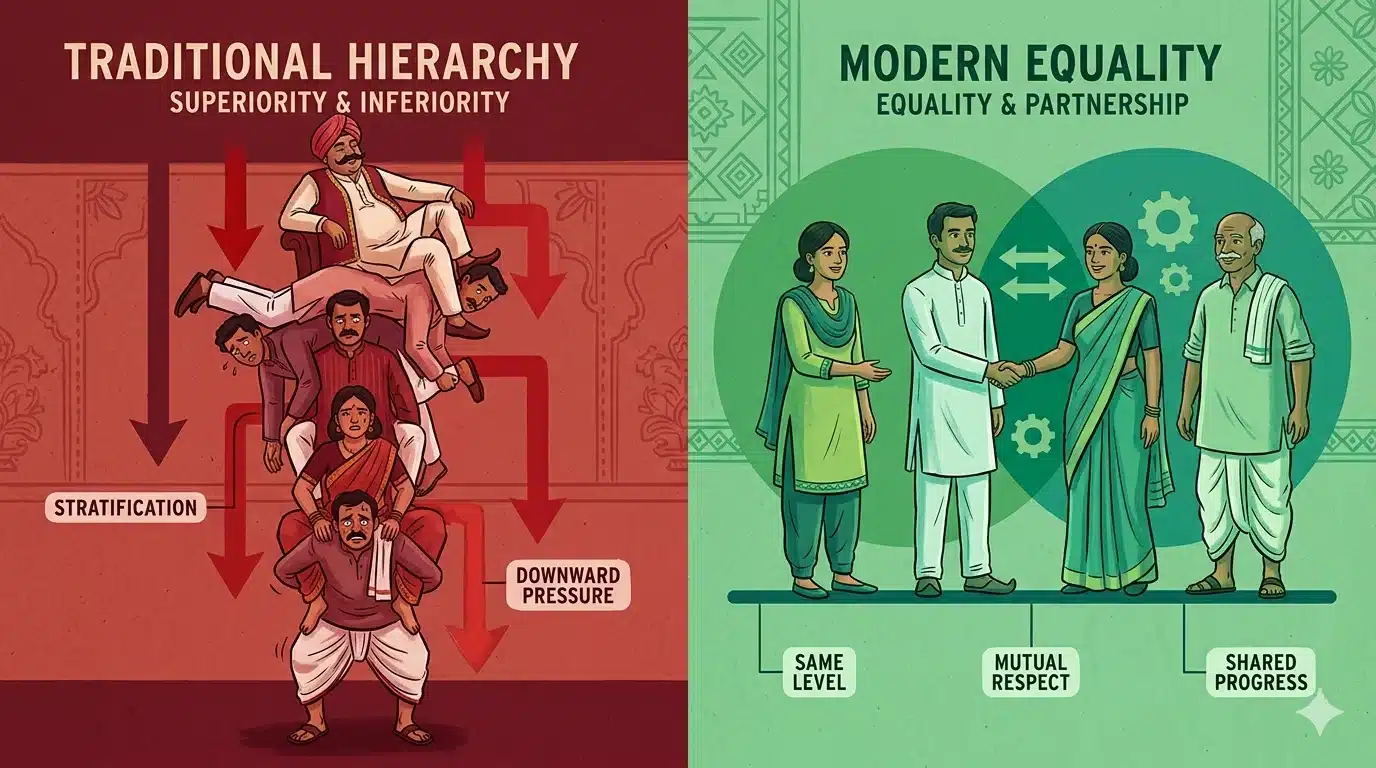
| Metric | Vertical Relationships (Problematic) | Horizontal Relationships (Solution) |
|---|---|---|
| Core Belief | लोग ऊपर-नीचे हैं (Superiority/Inferiority) | सब लोग Equal हैं, बस Roles अलग हैं |
| Comparison | हाँ—Self-worth Comparison पर टिकी है | नहीं—Self-worth Internal (खुद के अंदर) है |
| Approval-seeking | हाँ—दूसरों की Approval पर निर्भरता | नहीं—अपनी Values पर Focus |
| Control | दूसरों को Control करने की कोशिश | दूसरों को Respect करना, Control नहीं |
| Indian Example | “Boss मुझसे बेहतर है, मैं Failure हूँ” | “Boss और मैं दोनों Equal हैं, Roles अलग हैं” |
| Result | Inferiority/Superiority Complex | Community Feeling और Confidence |
🎯 इस जीवन-बदलने वाली पुस्तक को अभी खरीदें:
नीचे दिए लिंक्स सीधे एमेज़ॉन स्टोर के ऑफिशियल सर्टिफाइड एफ़िलिएट लिंक्स हैं:
🇮🇳 Indian Context: Office, Family, and Social Media
🏢 1. Office Politics & Hierarchy
Scenario: “शर्मा जी के बेटे को Promotion मिल गया, मुझे नहीं।”
Adlerian View: यह Comparison से पैदा हुआ Inferiority Complex है। जब आप Role को Vertical मानते हैं, तो आप Competition में जाते हैं। जब आप Horizontal मानते हैं, तो आप केवल अपने काम (Task) पर Focus करते हैं।
👨👩👧👦 2. Joint Family Dynamics
Scenario: Elder relatives का Constant Comparison और “लोग क्या कहेंगे” का Pressure।
Adlerian View: Joint families में Decisions अक्सर Collective होते हैं, जिसे Individual Choice को “परिवार का अनादर” कहकर Reject किया जाता है। यहाँ आपको Separation of Tasks की ज़रूरत है।
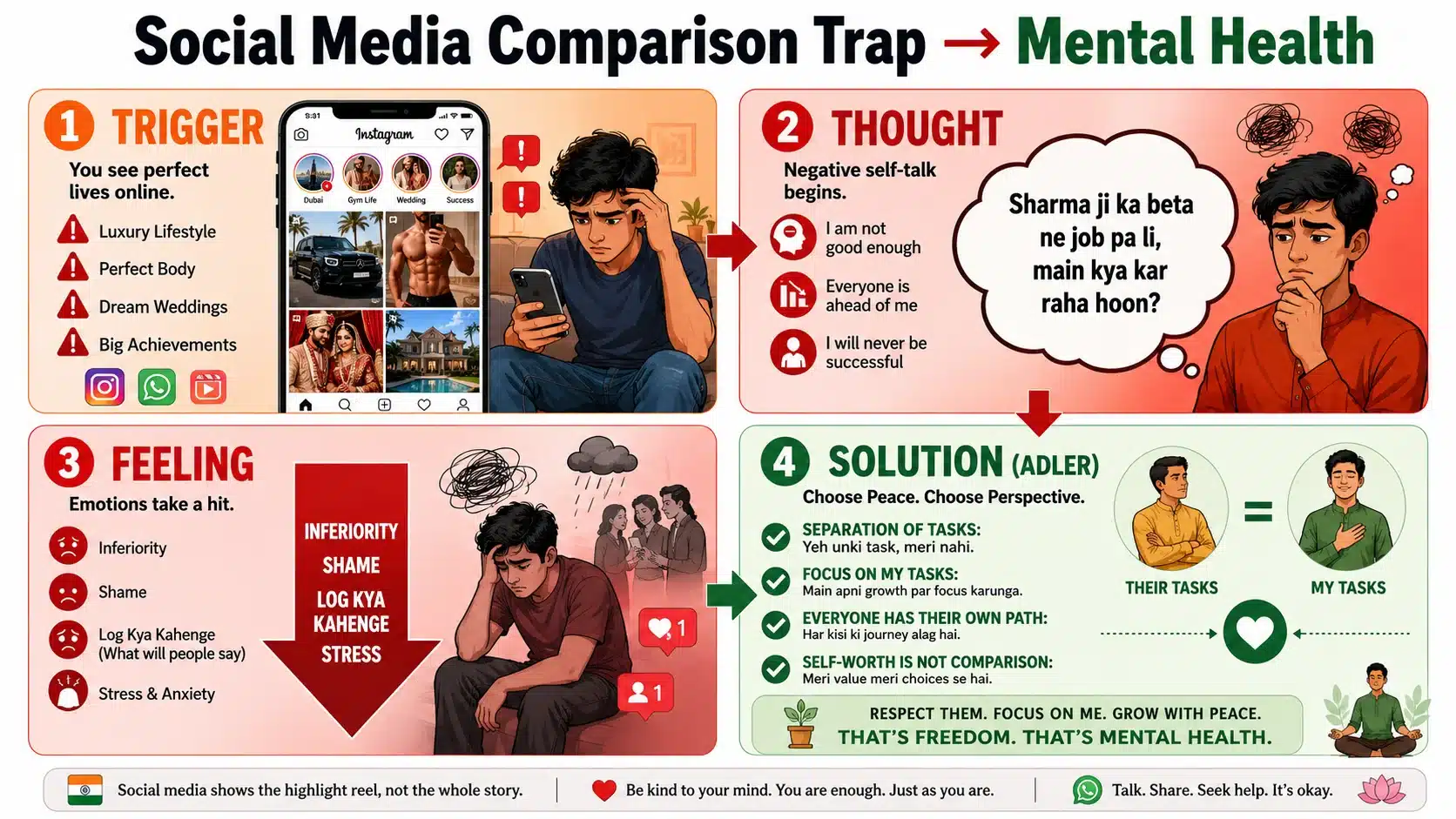
📱 3. Social Media & The Comparison Trap
Scenario: “कज़िन ने Luxury Car दिखाई, मैं क्या दिखाऊँ?”
Adlerian View: यह Approval-seeking और Comparison का चरम है। सोशल मीडिया पर हम दूसरों की नकली लाइफस्टाइल को देखकर दुखी होते हैं।
📊 RELATIONSHIP VISUALIZER MODEL
[Key Concept: Vertical = Comparison vs. Horizontal = Equality]
Superior (बॉस/पिता/सीनियर) → [तुलना + डर] → Inferior (आप/जूनियर) = मानसिक तनाव
व्यक्ति 1 (Role A) ↔ [समानता + सम्मान] ↔ व्यक्ति 2 (Role B) = असीम मानसिक शांति
PART 4: Community Feeling, The 5 Life Tasks, and the Art of Self-Acceptance
In Part 3, humne samjha ki kaise “Horizontal Relationships” humein competition se nikaal kar equality ki taraf le jaate hain. Lekin ab ek bada sawal khada hota hai: “Agar main sabka judgment ignore kar raha hoon, aur sabko barabar treat kar raha hoon, toh kya main duniya se kat (disconnect) nahi jaunga? Main logon se judunga kaise?”
Iska jawab chupa hai Adlerian psychology ke sabse sundar aur gehre concept mein: Community Feeling.
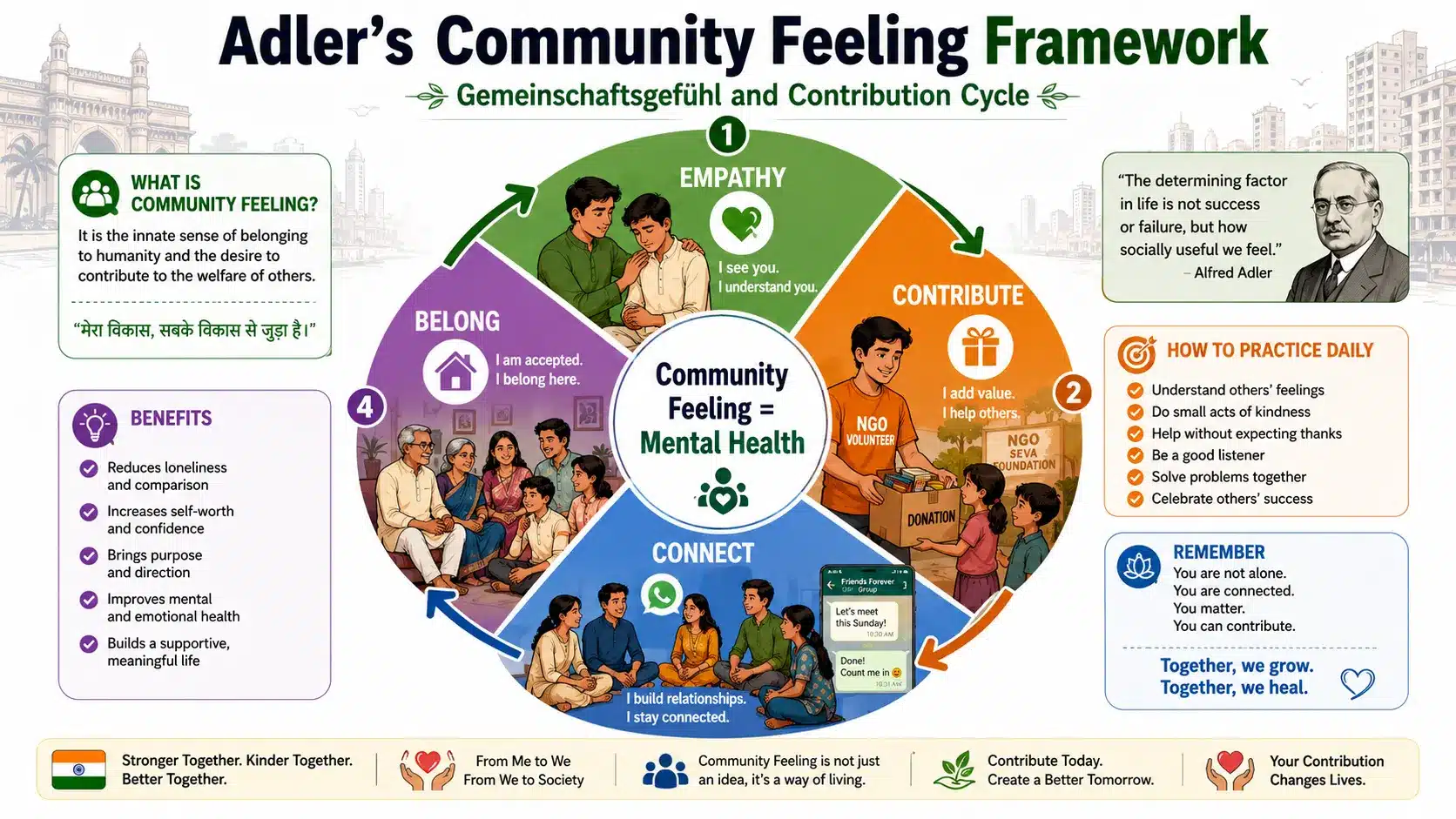
Community Feeling (Gemeinschaftsgefühl) — Sabse Bada Connection
💡 Community Feeling क्या है?
Community feeling (Gemeinschaftsgefühl) ka matlab hai: doosron ke saath genuine connection, empathy, aur social interest develop karna. Adler kehta hai ki mental health ka sabse bada indicator yeh hai ki aap doosron ke liye contribute karte ho—na ki sirf apne liye jeete ho। Jab aap ‘approval-seeking’ ke bajaye ‘contribution’ par focus karte hain, toh aap loneliness aur social anxiety se azad ho jaate hain।
Core Concept: Approval vs. Contribution
Hum sabko lagta hai ki connection tab banta hai jab log humein pasand karte hain (Approval)। Lekin Adler kehte hain ki approval ek ‘Vertical’ cheez hai—aap kisi ke niche jhuk rahe hain। Asli connection tab banta hai jab aap Contribution karte hain।
- Approval-seeking: “Kya woh mujhe pasand karenge? Kya main unke liye kaafi hoon?” (Focus on Self)।
- Contribution: “Main unki kaise madad kar sakta hoon? Main is group mein kya value add kar sakta hoon?” (Focus on Others)।
Jab tum kisi colleague ki help karte ho, ya apne parents ke liye koi chhota kaam karte ho—bina yeh soche ki woh tumhe ‘thank you’ bolenge ya nahi—tab tum ek connection banate ho. Connection ‘maanga’ nahi jata, connection ‘banaya’ jata hai through contribution.”
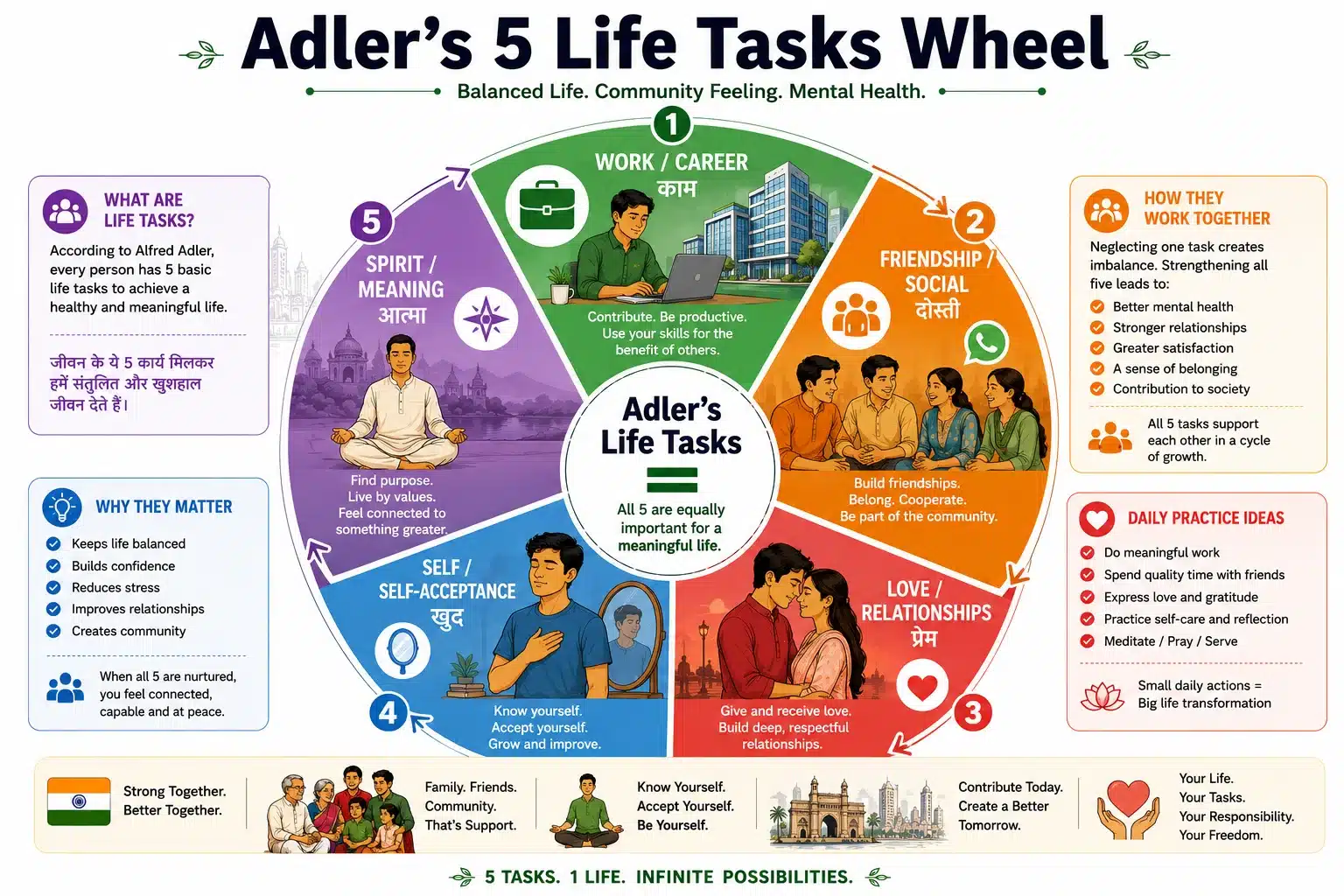
🛠 Adler’s 5 Life Tasks Wheel
Adlerian psychology ke mutabiq, hamari poori life 5 main ‘Tasks’ ke beech ghoomti hai. Agar aap inmein se kisi ek mein struggle kar rahe hain, toh uska asar aapki poori mental health par padega.
| Life Task | Focus Area | Vertical Trap (The Problem) | Horizontal Solution (The Fix) |
|---|---|---|---|
| 1. Work (Career) | Job, Business, Growth | Promotion ke liye dusron se competition karna. | Contribution aur humility ke saath kaam karna. |
| 2. Friendship (Social) | Dost, Social Circle | Friends ki approval ke liye khud ko badalna. | Genuine connection aur bina judgment ke saath rehna. |
| 3. Love (Relationships) | Partner, Shaadi | Partner ko control karna ya unse approval maangna. | Equality aur mutual respect maintain karna. |
| 4. Self (Identity) | Self-Acceptance | Khud ko criticize karna ya khud ko superior dikhana. | Khud ko imperfect maan kar accept karna. |
| 5. Spirit (Meaning) | Purpose, Spirituality | Religious superiority ya ‘main hi sahi hoon’ wali soch. | Community feeling aur life mein meaning dhoondhna. |
Self-Acceptance Deep Dive — Khud ko Kaise Accept Karein?
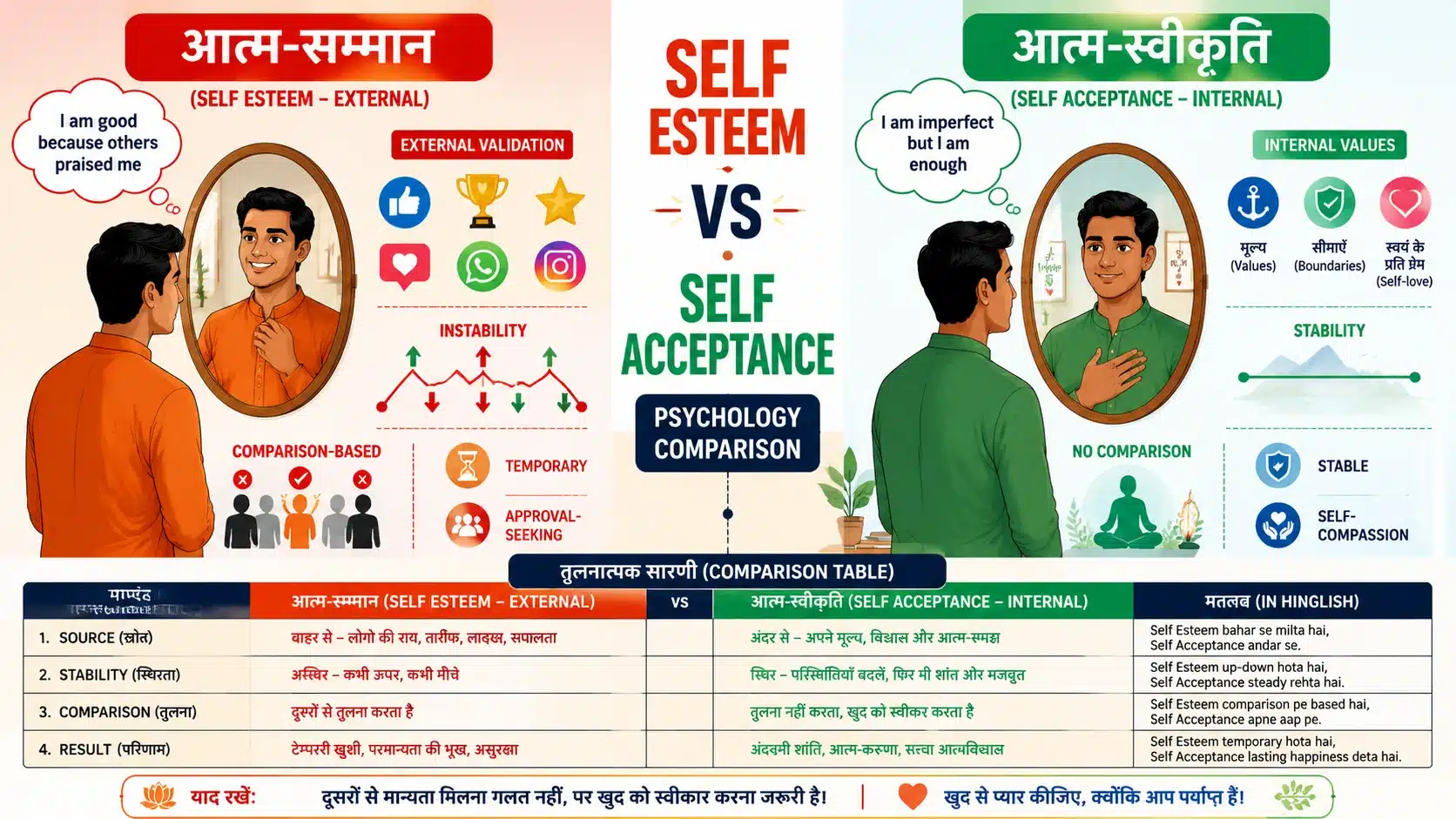
Hum sab ek ‘Perfect Version’ ke peeche bhaag rahe hain. Lekin perfection ek illusion hai. Adler kehte hain ki asli confidence Self-Esteem se nahi, balki Self-Acceptance se aata hai.
📊 Self-Acceptance vs. Self-Esteem
| Metric | Self-Esteem (External) | Self-Acceptance (Internal) |
|---|---|---|
| Core Belief | “Main accha hoon kyunki logon ne meri tareef ki.” | “Main imperfect hoon, par main kaafi hoon.” |
| Source | Doosron ki Approval (Unstable) | Khud ki Values aur Choices (Stable) |
| Comparison | Dusron se compare karke superiority dhoondhna. | Khud ke past se compare karna. |
| Indian Example | “Boss ne tareef ki, toh main successful hoon.” | “Mujhse galti hui, par main seekh raha hoon.” |
🛒 इस बेहतरीन किताब को अपनी पर्सनल लाइब्रेरी का हिस्सा बनाएं:
नीचे दिए लिंक्स सीधे एमेज़ॉन स्टोर के ऑफिशियल सर्टिफाइड एफ़िलिएट लिंक्स हैं:
🚀 5-Step Self-Acceptance Practice (Actionable Guide)
Agar aap “Sharma Ji ka Beta” wale comparison loop mein fase hain, toh ye practice aaj hi shuru karein:
📌 Related Posts Block:
- Self Acceptance Hindi Book: Khud ko Accept Karna Kaise Seekhein
- Separation of Tasks Adler Hindi: Step-by-Step Guide
- Log Kya Kahenge Ka Darr: 7-Day Challenge
PART 5: Practical Exercises, Action Checklists, and 60-Second Takeaways
अब समय है Theory को Action में बदलने का। केवल पढ़ना काफी नहीं है; Adlerian psychology को अपनी Life में उतारने के लिए आपको अभ्यास (practice) करना होगा।
Practical Exercises — Adlerian Psychology in Action (India-Optimized)
📌 Featured Snippet Block (Position Zero Target)
Adlerian psychology के Practical exercises में शामिल हैं: 5-minute reframing technique, “How to Start Being Disliked Today” action checklist, और 60-second takeaway bullet lists। ये exercises Indian readers के लिए tailor की गई हैं—ताकि आप Joint family, Career pressure, और “Log kya kahenge” वाले Stress को आसानी से handle कर सकें।
🛠 Exercise 1: 5-Minute Reframing Technique (Negative Thoughts को कैसे बदलें)
जब भी कोई Negative thought आए (जैसे: “मैं एक Failure हूँ”), तो इस Step-by-Step guide का पालन करें:
Dialogue: Youth vs Philosopher — The Reframing Power
🛠 Exercise 2: “How to Start Being Disliked Today” — 7-Step Action Checklist
अगर आप Approval-seeking के चक्रव्यूह से निकलना चाहते हैं, तो आज से ही यह Checklist शुरू करें:
- एक छोटा Decision लें: कोई ऐसा काम चुनें जिसमें आपको Approval का डर हो (e.g., “मैं Design field select कर रहा हूँ”)।
- Boundary Statement लिखें: मन में या Paper पर लिखें—“Yeh meri task hai.”
- Reaction को Release करें: यह मान लें कि दूसरों का Opinion उनका Task है।
- Small Action लें: तुरंत Action लें—Application भेजें या बात करें।
- Accept Response: जो भी Reaction आए, उसे Accept करें।
- Reflect करें: सोचें—“मैंने अपनी Task पर Action लिया, और मैं सुरक्षित हूँ।”
- Repeat: कल एक और छोटा Step लें जो बिना Approval के हो।
⚡ 60-Second Takeaway Bullet Lists (Daily Mental Hygiene)
इन Bullet points को अपने Phone के Notes में सेव कर लें और रोज़ाना पढ़ें:
📝 Takeaway: Self-Acceptance
- मैं Imperfect हूँ, पर मैं काफी (enough) हूँ।
- दूसरों की Approval पर निर्भर नहीं रहूँगा।
- छोटे Steps लूँगा जो मेरी Values के साथ हों।
- Fail हो या Succeed, मैं अपनी Journey को Accept करूँगा।
📝 Takeaway: Separation of Tasks
- क्या यह Decision मेरे Control में है? (हाँ = My Task)
- क्या यह दूसरों की Expectation है? (हाँ = Their Task)
- अपनी Task पर Focus करो, दूसरों के Reaction पर नहीं।
- Boundaries सेट करना Disrespect नहीं, Self-respect है।
📝 Takeaway: Horizontal Relationships
- सब लोग Equal हैं, बस Roles अलग हैं।
- Comparison बंद करो—Self-worth Internal बनाओ।
- दूसरों को Respect दो, Control करने की कोशिश मत करो।
- Community Feeling बढ़ाओ—Contribution पर ध्यान दो।
📝 Takeaway: Log Kya Kahenge (Stress Solution)
- Pause: 3 Deep breaths लें।
- Identify: “क्या यह मेरी Task है?”
- Boundary: “यह उनकी Reaction है—उनकी Responsibility है।”
- Action: अपनी Value के हिसाब से छोटा Step लें।
FAQs (अक्सर पूछे जाने वाले प्रश्न)
Is the courage to be disliked worth reading?
It depends on your interests and needs. If you are interested in philosophy and psychology, and want to learn more about the Adlerian approach to psychology, the book can be worth reading. Additionally, if you struggle with social anxiety, low self-esteem, or difficulty in relationships, the book may offer some insights and strategies for overcoming these challenges. The book has received positive reviews and has been translated into multiple languages, which suggests that many readers have found it helpful and informative.
What are the key points in the courage to be disliked?
Here are some key points from “The Courage to be Disliked”:
1. The key to happiness is to live in accordance with your own values and goals, rather than seeking approval and validation from others.
2. Our past experiences do not determine our future, and we have the power to change our attitudes and behaviors in the present moment.
3. We should take responsibility for our own lives and not blame external circumstances or other people for our problems.
4. Relationships are based on mutual respect and trust, and we should avoid becoming dependent on others for our happiness.
5. We can overcome social anxiety and improve our relationships by focusing on the present moment, rather than worrying about past or future events.
6. We should view mistakes and failures as opportunities for growth and learning, rather than as reasons to feel ashamed or discouraged.
7. The Adlerian approach to psychology emphasizes the importance of social interest, which is the capacity to work for the common good and contribute to society.
8. Happiness and fulfillment come from being true to yourself and pursuing your own goals, rather than conforming to societal expectations.
These are just a few of the key points from the book, and there are many more insights and ideas presented throughout the chapters.
What is the main idea of courage?
The main idea of courage is the willingness to face fear, danger, or uncertainty in order to achieve a goal, uphold a value, or defend a principle. Courage involves taking action despite the presence of fear and often requires a certain level of risk or sacrifice. It can take many forms, such as physical courage, moral courage, or emotional courage, and is often seen as a necessary attribute for personal growth, success, and fulfillment in life.
Adlerian Psychology Kya Hai?
Adlerian psychology Alfred Adler ne develop kiya, jo ek Austrian psychologist the. Yeh Freud se 3 main differences mein alag hai:
Feature
Adlerian Psychology
Freudian Psychology
Focus
Present goal par focus
Past trauma par focus
Cause
“Main kya chahta hoon?”
“Mujhe kya hua tha?”
Control
Aap control kar sakte ho
Past ne control kiya
Adler kehte hain: “Trauma nahi exist karta” — yeh ek story hai jo aap khud ko batate ho. Aap present moment mein apna goal set karke life change kar sakte ho.
Self-acceptance aur self-esteem mein kya difference hai?
Aspect
Self-Esteem
Self-Acceptance
Source
Doosron ki praise/sehat
Khud ki values
Stability
Temporary (upar-neeche)
Stable (internal)
Comparison
Haan (Sharma ji ka beta)
Nahi (khud se compare)
Result
External confidence
Internal confidence
Self-acceptance ka mantra: “Main imperfect hoon, par main kaafi hoon.” Yeh Adlerian psychology ka core principle hai.
Separation of tasks kya hai aur yeh Indian context mein kaise apply karein?
Separation of tasks ka matlab hai: “Har insaan ki apni zimmedari hoti hai”
Indian Examples:
Scenario
Kiski Task?
Kya Karna Chahiye?
Parents ne marriage pressure diya
Parents ki task
Unki concern suno, par apna decision lo
Boss ne criticize kiya
Boss ki opinion
Feedback lo, par self-worth par dhyan mat do
Log kya kahenge?
Doosron ki soch
Ignore karo, apne values pe focus karo
Rule: “Jo result aap control kar sakte ho, woh aapki task hai. Jo nahi kar sakte, woh doosron ki task.”
“Log kya kahenge” wala stress kaise kam karein?
3-step technique:
Recognize: “Yeh doosron ki task hai, meri nahi”
Reframe: “Unki soch unki zimmedari, meri choice meri zimmedari”
Act: Apne values par kaam karo, approval ki chinta mat karo
Adler quote: “Freedom ka matlab hai logon ki fear ko chhod dena.”
Indian context mein: UPSC/IIT/shaadi pressure mein yeh technique kaam aati hai.
Adler kehte hain trauma nahi exist karta — kya woh sahi keh rahe hain?
Adler ka point hai: “Trauma cause nahi hai, story hai”
Freud: Past trauma ne aapko tod diya
Adler: Aapne trauma ko “reason” banaya present mein excuse ke liye
Example:
“Mujhe school mein bully kiya tha → main social nahi hoon” (Freud)
“Main social nahi hoon → isliye school bullying ka use karta hoon reason ke taur par” (Adler)
Adler nahi kehte ki trauma nahi hua. Woh kehte hain: “Aap present moment mein choose kar sakte ho trail chhod kar nayi path par chalna.”
Adler ne horizontal relationships kyun bola?
Horizontal relationships = “Sab equal hain, upar-niche nahi”
Vertical Thinking
Horizontal Thinking
“Main aapko praise karunga agar aap achha karo”
“Main aapko respect deta hoon, chahe kuch bhi ho”
Judge karna
Appreciate karna
Approval-seeking
Self-defined
Indian context:
Parent-bachcha: “Tumhare marks achhe hain, tabhi main khush hoon” (vertical) vs “I’m proud of your effort” (horizontal)
Boss-employee: “Agar target pura kiya toh bonus milta hai” vs “Your contribution valued hai”
Community feeling kya hai aur yeh mental health se kaise connect hai?
Community feeling (Gemeinschaftsgefühl) = “Doosron ke liye contribute karna”
Low Community Feeling
High Community Feeling
“Main akela hoon”
“Main community ka hissa hoon”
Self-centered
Others-minded
Depression/anxiety
Purpose/meaning
Indian examples:
Volunteer karo local NGO mein
Family mein contribute karo (joint family system)
Office mein colleagues ki help karo
Result: Internal confidence milta hai, external approval ki zaroorat nahi
5 Life Tasks Kya Hain?
Task
Hindi
Indian Context
Work/Career
काम
UPSC/IIT/job pressure
Friendship
दोस्ती
Social anxiety, WhatsApp group
Love/Relationships
प्रेम
Arranged marriage, relationship stress
Self/Self-Acceptance
खुद
Self-doubt, comparison
Spirit/Meaning
आत्मा
Life purpose, spirituality
Adler: “Har task mein horizontal relationships aur community feeling zaroori hai.” Ek task fail ho toh baaki bhi affect hote hain.
5-minute reframing technique kaise use karein?
5 steps:
Pause (30 sec) — Deep breaths, stop reactive thinking
Identify (1 min) — Catch negative thought (“main failure hoon”)
Reframe (2 min) — Replace with empowering thought (“imperfect par kaafi hoon”)
Action (1 min) — Take small step forward
Accept (30 sec) — Accept result, move on
Example:
Negative: “Boss ne criticize kiya → main failure hoon”
Reframe: “Boss ne criticize kiya → main imperfect hoon, par seekh raha hoon”
“The Courage to Disliked” kisse padhni chahiye?
Yeh book padhni chahiye agar:
✅ Logon ki fear se juda hua hai
✅ Parents/family pressure se struggle kar rahe ho
✅ Self-doubt aur comparison se pareshan ho
✅ Career/relationship mein stuck feel karte ho
✅ External validation par depend ho
Best for: 20-35 age group, UPSC/IIT aspirants, corporate employees, arranged marriage stress mein log.
Book length: 5 Sessions (philosophy dialogue format), easy to read.
Must Read Book Summaries
(अन्य बुक समरीज़)
- As a Man Thinketh Summary in Hindi: 7 Life-changing Insights
- (James Clear) Atomic Habits Book Summary in Hindi: The 1% Solution to a Better Life
- The Power of Your Subconscious Mind Summary in Hindi- 20 Mind-Blowing Ways to Harness the Power of Your Subconscious Mind.
- The Power of Positive Thinking Summary in Hindi-16 Powerful Ways To Transform Your Mindset
- Rich Dad Poor Dad Summary in Hindi-10 Lessons on Financial Literacy.
- Think And Grow Rich Summary In Hindi | सोचो और अमीर बनो
- Ikigai Book Summary in Hindi- Ikigai ढूंढने के 4 secret तरीके
- The Richest Man In Babylon Summary In Hindi- 7 Secrets to Become Rich
- The Secret Book Summary in Hindi- 3 अदभुत रहस्य मनचाही चीज़ पाने के
- The 7 Habits Of Highly Effective People Book Summary in Hindi (Complete)
- The Psychology of Money Summary in Hindi (Morgan Housel): 10 Key Money-Making Principles
- The CEO Factory Book Summary: A Comprehensive Guide to Business Success
- The Intelligent Investor Book Summary in Hindi: The Definitive Guide to Value Investing in 2023
- The Millionaire Fastlane Book Summary In Hindi: The Ultimate 10-Step Blueprint
- Chanakya Neeti Book Summary in Hindi-7 Secrets to Success
- The Alchemist Book Summary in Hindi: 7 Powerful Insights
- Attitude Is Everything Book Summary In Hindi: 5 Life-Changing Principles
- (Vatsyasyana)Kamasutra Book Summary in Hindi: 10 Secrets to a Great Sex Life
- (Peter Theil)Zero To One Book Summary in Hindi- 10 Lessons on the Power of Innovation to Create Wealth
- Sapiens Book Summary in Hindi- मानव जाति का संक्षिप्त इतिहास
- (Daniel Kahneman)Thinking Fast and Slow Summary in Hindi- 5 Powerful Insights.
- The Courage To Be Disliked Summary In Hindi- 5 Key Takeaways
- The Compound Effect Summary in Hindi: How to Achieve Your Goals with 1% Daily Progress
- The Almanack of Naval Ravikant Summary in Hindi: 4 Ways to Empower Your Life
- The Power of Now Summary in Hindi: 10 दिनों में तनाव कैसे दूर करें
- The Subtle Art of Not Giving a F*ck Summary in Hindi: 10 Powerful Lessons
- The 5 AM Club Summary in Hindi: 10 Powerful Habits for Success
- The Total Money Makeover Summary in Hindi: The 7 Baby Steps to Financial Freedom
- The Muqaddimah Summary: The 14th-Century Book By Ibn Khaldun That Changed the Way We Think About History
- The Wealth of Nations Summary: 10 Powerful Insights That Will Revolutionize Your Understanding of Economics
- The Communist Manifesto Summary: 5 Key Ideas That Shook the World
- A History of the Sikhs by Khushwant Singh: 10 Things You Need to Know about Sikhism
- Men Are From Mars Women Are From Venus Summary in Hindi: The 4 Key Differences Between Men and Women
Conclusion: निष्कर्ष — आपका अगला कदम क्या होगा?
Alfred Adler की यह Psychology हमें सिखाती है कि खुश रहने और आज़ाद होने के लिए किसी चमत्कार की नहीं, बल्कि एक गहरे साहस (Courage) की ज़रूरत होती है—दूसरों की नजरों में ‘नापसंद’ होने का साहस। जब आप Separation of Tasks को मास्टर कर लेते हैं और अपने रिश्तों को Vertical के बजाय Horizontal धरातल पर ले आते हैं, तो “लोग क्या कहेंगे” का सदियों पुराना डर अपने आप समाप्त हो जाता है।
याद रखें, खुद को उसकी तमाम कमियों के साथ स्वीकार करना (Self-Acceptance) और बिना किसी वैलिडेशन की उम्मीद के समाज में अपना योगदान देना (Contribution) ही सच्ची मानसिक आज़ादी है।
📖 क्या आप इस पूरी किताब को विस्तार से पढ़ना चाहते हैं?
इस अद्भुत विचार-प्रवाह को अपनी लाइफ का हिस्सा बनाने के लिए आज ही नीचे दिए लिंक्स से अपनी कॉपी आर्डर करें: